
Leadership Development Strategies for Success at Work: A Step-by-Step Guide

Unlock your leadership potential with my step-by-step guide. From self-assessment to continuous learning, discover my keys to your success at work.


Leadership development strategies are crucial for executive success.

They equip leaders with the necessary skills and knowledge to guide their teams effectively, drive organisational growth, and adapt to changing business landscapes.

Without leadership development, executives risk stagnation, decreased team performance, and ultimately, a decline in organisational success.


Here are the key steps to take

Step 1: Self-Assessment

Self-assessment is the foundation of leadership development.

It involves a critical evaluation of one’s strengths and weaknesses. This introspection helps identify areas for improvement.

  • An executive might use tools like 360-degree feedback or personality assessments to gain a comprehensive understanding of their leadership style and areas that need improvement.

Step 2: Setting Leadership Goals

Goal setting is a pivotal step and the GROW model is a good one to use when setting out on the developmental journey.

The GROW model involves setting a Goal, understanding the current Reality, exploring Options, and determining the Will to achieve the goal.

  • An executive aiming to improve their communication skills might set a specific goal to deliver clear and concise team briefings (Goal), acknowledge their current tendency to provide too much information (Reality), explore options like communication workshops or coaching (Options), and commit to practicing concise communication in daily meetings (Will).

Step 3: Seeking Feedback

Feedback is a valuable resource for leadership development.

It provides insights into how others perceive your leadership style and effectiveness. Constructive feedback can guide your development process.

  • An executive might implement a regular feedback system, such as anonymous surveys or open feedback sessions, to gain insights into their team’s perception of their leadership style and identify areas for improvement.

Step 4: Investigating Development Opportunities

Exploring leadership development opportunities supported by your organisation is crucial.

These programs, along with other opportunities like secondments and volunteering, provide practical leadership experience.

  • An executive might participate in a company-sponsored leadership workshop or seek a secondment opportunity in a different department, or even to a supplier or third-sector organisation, to gain a broader perspective and enhance their leadership skills.

Step 5: Raising Awareness of Others

Understanding others is a key aspect of emotional intelligence in leadership.

This involves recognizing others’ motivations and values, which can enhance team dynamics and effectiveness.

  • An executive might conduct regular one-on-one meetings with team members to better understand their motivations, career aspirations, and values, and then tailor their leadership approach to better align with these insights.

Step 6: Implementing Coaching and Mentoring

Coaching and mentoring play a significant role in leadership development.

These relationships provide personalized guidance and feedback, enhancing your leadership skills.

  • An executive might engage a professional coach to refine their communication skills, and also mentor a junior employee themselves. Which not only provides a fresh perspective but also helps in developing their leadership skills through teaching.

Step 7: Practising Leadership Skills

Practice is essential for honing leadership skills.

New skills and behaviours should be practised in a safe environment to encourage growth and development.

  • An executive might practice their decision-making skills by taking the lead in smaller projects before taking on larger, organisation-wide initiatives.

Step 8: Reflecting on Progress

Self-reflection can be an information-rich part of leadership development.

It involves reviewing your progress, learning from experiences, and making necessary adjustments.

  • After a major project, an executive might conduct a reflective session, analysing the project’s successes, challenges, and their personal performance, to identify lessons learned and plan for future improvements.

Step 9: Continuous Learning

Leadership development is a journey of continuous learning rather than a destination.

Staying updated with the latest leadership trends and theories can provide new insights and strategies.

  • An executive might commit to reading a new leadership book each month, subscribing to relevant industry podcasts, or attending annual leadership seminars to stay abreast of new developments in leadership theory.

The journey of leadership development is a continuous and rewarding process.

Each step you take not only brings you closer to becoming a more effective leader but also contributes to the success of your team and organisation.

The key to executive success lies in continuous learning, adaptation, and the courage to step out of your comfort zone. Embrace this journey with an open mind and a committed heart, and watch as you transform not just yourself, but your entire organisation.

Let me know what your top leadership development tips are? And what do you most want to learn about, as a leader? Share on X

What doesn’t kill you

New research suggests that we should stop saying “What doesn’t kill you makes you stronger” – Because it doesn’t!

I found some interesting research recently, based on the experiences of people in Chile and neighbouring countries who went through devastating earthquakes and a tsunami in 2010 (link to full article below).

In short, those people who had previously experienced four or more ‘stressors’ were at a much greater risk of developing a post-disaster mental health disorder compared to those who had experienced few or no prior stressors.

The researchers defined a ‘stressor’ as serious illness or injury, death of a loved one, divorce, unemployment or financial struggles, legal troubles or loss of a valuable possession.

In the world of people development, it’s very common to see that “What doesn’t kill you …” quote from Nietzsche used with the intention of boosting people’s confidence or resilience in the face of extreme difficulty. It’s the so-called “stress inoculation hypothesis”.

But some Nietzsche scholars believe that the German philosopher was actually poking fun at the kind of thinking which regards repeated adversity as a source of strength. It was common for Nietzsche to do this – say one thing, but mean another. It’s perhaps unfortunate that his pithy sayings are so quotable!

As usual, I wonder if the truth is somewhere in the middle:

  • It’s clear from the Chilean research that repeated exposure to stressful experiences makes you more vulnerable to negative impacts from extreme events – not stronger at all
  • But perhaps it’s possible that it does make you more empathetic towards others who have also experienced stressful times? In itself, this is a very useful success skill.

Similarly, a big cause of stress in life and at work is the gap between our expectations of how things somehow “should” be – and how they really, actually are:

  • In times of stress, that gap can seem huge (“My life and work should be successful/happy/fulfilling/safe – but it is actually not”);
  • Perhaps it’s also possible that exposure to stressful experiences gives us a kind of, if not inoculation, than maybe a kind of world-weary assumption that sh*t does occasionally happen – and maybe that helps a little?

Let me know what you’re noticing about the impact of stressful events on your own resilience please.

Click here to see the research article.

The Antidote for too much Snippiness at Work is more Self-Compassion

I’ve noticed there’s a lot more snippiness at work at the moment than is good. People losing their temper and sounding-off; others fault-finding and blaming when there really isn’t any need. I’ve seen it in a couple of board-meetings and in some team-working just over the last few weeks.

Given the circumstances right now, it’s understandable that people might be more stressed than usual and end-up taking it out on others. The answer is to take better care of ourselves first.

Fortunately, I’ve also noticed that there’s much more awareness of how this kind of behaviour in a group or team setting is ‘sub-optimal’ than there was, say ten years ago.

Lots of really useful concepts have made their way into our everyday language:

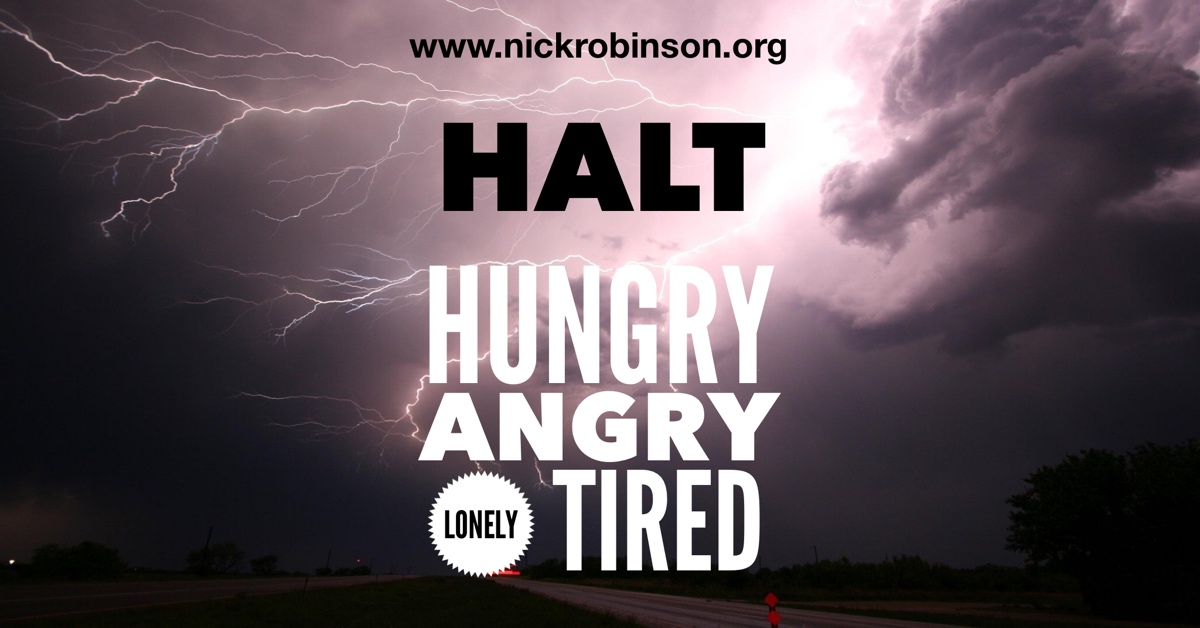
Things like “Hangry” – a portmanteau of hungry and angry, where someone’s hunger is making them increasingly upset, irritable or even angry.

I’ve even heard people use the HALT acronym – derived from addiction recovery, it reminds people to take a moment (HALT) and ask if they are feeling Hungry, Angry, Lonely, or Tired. It seems simple enough, but when those basic needs are not met, people can be susceptible to destructive behaviours.

The importance of this kind of stuff, in terms of doing well at work, can’t be overstated. Years of co-operation can be written-off with a badly-timed and unfair outburst. Credibility as a competent manager can be lost by a poorly-judged public criticism. Trying to get stuff done when you don’t have a good relationship with the people you depend on is non-starter.

I use my own modified (and backwards) version of the Emotional Intelligence model to help unpick and re-wire how we behave at work. In simple terms, it looks like this:

Leading < Relating < Self-Management < Self-Awareness

If you want to lead well (which is basically, getting stuff done with the co-operation of others), then you need to be aware of how other people are feeling and doing, and manage your relationship with them. And you can’t do that without being aware of how you yourself are doing and then effectively managing your own behaviours.

Start with that Self-Awareness step:

  • Are you Hangry?
  • Do you need to HALT?
  • Are your anxieties taking over?
  • If you were able to be more compassionate with yourself, what would you do?

Let me know what you’re noticing about your self-management these days please?

Thinking is more painful than electric shocks!

Why people often don’t get clear about their desired outcome or choose the best approach to take, before they act

It’s helpful for people to think about stuff more – particularly on why  they’re about to do something and on how  they’re about to do it. This is because:

1. Knowing why  we’re about to do something – the outcome we want to achieve – is much more important than the first few steps, the tactics, that we might take to get to it.

It’s easy to grasp this. If your desired outcome is clear but the first few steps you take towards it don’t work, you can simply try some other tactics. But if you start from the tactics themselves without really being clear about where you’re trying to get to, then early failures tend to derail all your efforts.

(There are exceptions to this rule: notably if you’re stuck and don’t know what you want to achieve then just trying something – anything – can be sometimes be more empowering than staying stuck);

2. Actively choosing how  we’re going to do something – the strategy, route or approach we might take – is a key determiner of success.

Far too many people simply do everything the same way, or the same way that they did it before, regardless of whether or not this gets results. It’s where that old saying comes from, “If you’ve only got a hammer, everything starts to look like a nail.” Actively choosing the way to go about doing things, dependent on the circumstances and the people involved, creates flexibility of approach. And flexibility of approach in our behaviour is what leads to win-win.

Why don’t people do this kind of thinking more?
Get clear about their desired outcome and choose the best approach to take, before they act?

One part of the answer is in an article I was delighted to discover recently, headlined “People Would Rather Experience An Electric Shock Than Be Alone With Their Thoughts”!

A team of researchers have discovered that:

  • Left alone in a room with just their thoughts, more than half the participants described the experience as ‘not enjoyable’, most found it difficult to concentrate and reported their minds wandering. The negative aspects went up further in another group who were asked to repeat the task at home;
  • In one experiment people had the option of giving themselves an electric shock rather than complete the full thinking time. Even though they’d had that level of shock before and had said they’d pay $5 not to be shocked again, 67% of the men and 25% of the women involved chose to shock themselves rather than just sit and think!

You can see their article here: https://www.sciencemag.org/news/2014/07/people-would-rather-be-electrically-shocked-left-alone-their-thoughts

My take on this is that human minds are evolved to deal with the real, physical world and with the web of social relationships that it takes to thrive. Disengaging from actual, concrete tasks and from real interactions with others long enough to do this kind of outcome/approach thinking is not something we’re naturally evolved to do. We have to learn it. And sticking with it long enough to get results ‘hurts’ and takes a lot of energy. Similarly, if you’re anything like me, there’s a whole load of failed adventures, thwarted ambitions and personal shortcomings that I’d really rather not think about at all, if only if wasn’t for the chance to improve things in future.

As my coaching practice evolves, I find that more and more people are saying things like: “I just need to hear myself think out loud”, or “I need some space to reflect on things and work them out, a kind of sounding board.” The hardest thing to do when I’m coaching in that kind of situation, is to do nothing but listen – but at least I don’t feel the need to give myself electric shocks!


Let me know if you’ve noticed any of this too please – or what you’re discovering about thinking, outcome-focus and behavioural choices yourself.

Keeping your mind fresh and flexible

When was the last time you travelled home from work on a different route to normal?

In my coaching work I often encourage people, especially those who are maybe a little stuck or who want to up their game, to go and seek out variety and unpredictability.

This is important because so much of what we do, what we say and how we think, is driven by habit. Habit is useful, because it’s ‘expensive’ from a brain-power point of view to have to stop and think about things before we do them. Being on autopilot is efficient. And yet, if habit is all that drives us, how do we develop, learn and grow?

I’ve long argued that the extra brain-expense of doing things like driving home on a different route every now and then, is a good investment, because it helps our brains make new connections and be more pliable. Those connections and that pliability are extremely useful for increased problem-solving and mental and sensory acuity – the ability to spot information and recognise patterns.

So it was interesting reading Steven Kotler’s book “The Rise of Superman – decoding the science of ultimate human performance,” in which Kotler cites unpredictability and novelty as being essential steps towards achieving what athletes call flow state.

“[things like] brushing your teeth with the wrong hand,” says Kotler, “…increases novelty and unpredictability, demanding focus and pattern recognition.”

I’m still only half-way through that book and undecided about just how useful it might be, but it’s nice to see others also emphasising these points. Kotler also goes on to quote renowned neuroscientist James Olds as saying that new routines in our daily lives produce dopamine and norepinephrine, the feel-good chemicals that our brains use to amplify focus and enhance performance. In fact, I got really excited, because Kotler then says that James Olds practices what he preaches by driving home from work a different route every night!!

Just what I’ve been telling people to do for years!

I’m interested in how you keep things fresh and your brain nice and flexible? How do you make sure that not everything you do is driven by habit or routine?

Health and Work

Well-being has a huge impact on success at work. Can you be physically and emotionally healthy and hold down a demanding job?

Modern working life seems to make it tough to be healthy physically.

I’m struck by how many of my clients are dealing with poor-ish health. They’re often carrying minor health issues that haven’t been (or can’t really be permanently) ‘fixed’. They suffer from problems caused by sitting around in front of a screen all day, from long hours and the impact this has on diet, from emotional eating and drinking in response to the stresses and strains of demanding jobs, and from frequent coughs and sneezes.

And I write this, as it happens just a few days away from the shortest, darkest day of the year, when dealing with those health-related issues seems harder than ever.


I know these are all “first-world” problems really.

In the scheme of things, my bad back, caused by such a sedentary working day, is just a minor niggle. Yes, I can get a bit snappy and do tend to take the worry home with me if I’ve had a particularly stressful day. And yes, the coffee I’m chugging all day to raise enough energy to get through the afternoon does make me sleep poorly, but at least I’ve got somewhere safe and warm to sleep – it isn’t really such a big issue, is it?

Except it is a big issue really.

In a big picture sense, it’s an important issue because in the UK just those factors of stress, anxiety and musculoskeletal disorders account for around 20 million lost working days every year (HSE link).

On a more individual level, I think it’s also a big issue, because poor physical health and un-managed stress have such a huge impact on emotional well-being. And emotional well-being is the key to the self-awareness and good relationship-management that actually drives so much of our success (or otherwise) at work.

As Bruce Lee famously said:

You cannot pour from an empty cup.

If our physical and emotional reserves are low, our interactions with colleagues will be less effective and our work will suffer.


Not all of my clients are dealing with poor-ish health though. Some put a lot into maintaining their health and do it very successfully. And of those who do carry health conditions that will aways need managing, some manage them very well indeed.

My own health and emotional well-being seems to go up and down in long phases. I can have many years where I’m cycling or running regularly, eating healthily and living a well-balanced life, and then something happens to knock that off course and it might take a couple of years for me to get it back on track again.

I don’t know what the key to the physical side of all this is.

Having read about and trained with and followed a number of regimes, I still couldn’t say “Here are the seven steps to psychical well-being” with anything like certainty.

I do know that for me, changing things for the better has often involved quite small starts – deciding to go out for 20 minute walk at lunchtime no matter the weather, for example. Or just mentioning I was feeling physically drained to a friend resulting in an unexpected invitation to a long-distance bike ride – with enough time to train for it!

Actually, maybe those are part of the key:

  • Do something small; and
  • Reach out and ask for help.

What’s your experience been – how’s your health and well-being; does it have an impact on your ‘success’ at work; how did you change your health for the better?


Leaders cannot NOT be role-models – so be the right kind

I know I keep banging on about this, but Behaviour is such an important thing for leaders to get right.

If you have any kind of authority, responsibility, power or even visibility in your organisation, other people will base their own Behaviour on yours.

This applies whether or not you’re formally called a ‘leader’ or ‘manager’ or whatever. You cannot not be a role-model; so be the right kind.

If you want to know who in your organisation sets the standard for how things are done and what’s the right way to Behave with each other – take a look in the mirror. If you find yourself complaining or worrying about some aspect of the culture in your business, the person looking back at you from that mirror is the one who sets the tone.


People sometimes ask me, “Well, what do you even mean by ‘Behaviour’?”

The answer is simple – everything you do and everything you say.


What makes things tough for leaders and anybody who wants to manage their own Behaviour, is that what you say and do on the outside is actually the end result of a long chain of stuff that happens inside our heads and bodies – and which is often largely unconscious.

To make a start in managing your own Behaviour I recommend two simple actions:

  • First, as you interact with others, be very clear about what outcome you want to achieve. Behaviour without Intention is not managed. Remember:

You cannot hit a target which is not there

  • Second, have some kind of ‘Reflective’ practice. The best way is to keep a diary or journal where you can reflect on your day and set your intentions for the next.

You know yourself mostly by your thoughts. Everyone else in the world knows you only by your actions. Remember this when you feel misunderstood. You have to do or say something for others to know how you feel.

James Clear


What aspects of being a role-model, or of Behaviour at work are important to you?

Nick Robinson Executive Coaching - Kindness at Work

Working Kindness

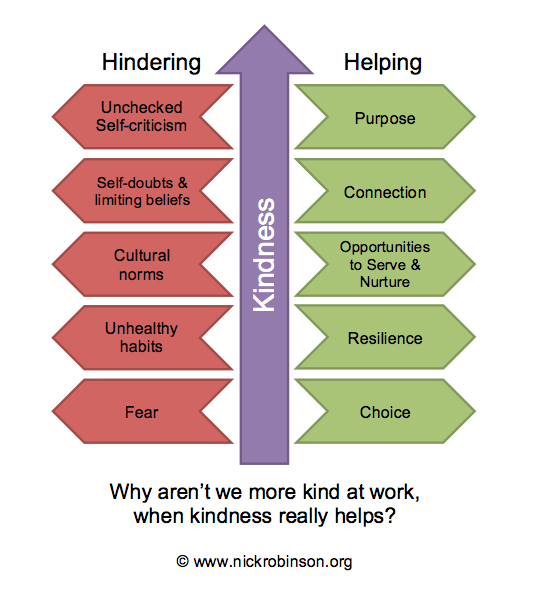
Why aren’t we more kind at work, when kindness really helps?

I write this at the end of a busy month, which has given me another great opportunity to ask people about one of my current themes: kindness.

The reason I’ve been asking about kindness is down to my previous month’s coaching work. This was absolutely packed with situations where I couldn’t help thinking that maybe just a little bit of kindness would have dealt with everything even before I’d arrived!

There’s variety in my work and so it’s good that I also get to work with people in some very successful businesses and organisations where kindness is a way of doing things. In fact, some of the most successful leaders I know are very good indeed at doing kindness and I can’t help feeling that in the long-run, there’s probably a high correlation between the two.

I know there’s an emotional side to this. The sort of world I want to live in and to leave for my son, is driven by kindness. I want there to be room to care for and raise-up others to their full potential. And for me, there’s also a really practical side. I love being able to do things well, and doing them well also means doing them effectively – with efficacy, efficiency and gracefulness. If I genuinely thought that being unkind was more effective in the long run than being kind, I’d probably give it a go! But I just don’t see it. What I do see is opportunity wasted, potential unused and crucial errors being allowed.

Human beings are practically hard-wired to both take care of themselves and to take care of each other because of our evolution as social animals. The basic tools to be kind to each other, and the practical reasons for doing so, are already available to us. So, if we’re not being kind, there must be a reason. And, if there’s a reason, there’s also got to be a way to create the right conditions for more kindness.

Here’s my thoughts so far.

Unchecked self-criticsim vs. useful Purpose

In my experience as a coach, people who are critical of others in a damaging rather than useful way are often unconsciously highly-critical of themselves. With that going on in the back of their minds it’s very hard to be supportive of others. Contrast that with the joy of being around someone who has a genuine sense of Purpose, something meaningful to work on and who will carry you along in their enthusiasm.

Self-doubts and limiting beliefs vs. Connection

Some people let the self-doubts, the “I can’t”s and the “It never works for me”s, take over the focus of their attention. This self-limiting place is one where there’s no spare energy, time or resources to be kind to others. It’s a place where kindness looks dangerous, like a zero-sum game of winners and losers. They say that you become the average of the people you spend time with and it seems true to me that having quality time Connected with people who don’t think like that is a great enabler of kindness

Cultural Norms vs. Opportunities to Serve & Nurture

Perhaps one of the biggest barriers to having more kindness at work is “the way things are done around here”. Just like individuals, organisations have an unconscious set of stories, beliefs and self-criticisms. Left unchecked, Cultural Norms can become very damaging to an organisation’s ability to make the most of its people. As an antidote, creating Opportunities to Serve and Nurture, as many companies are doing with community and volunteering initiatives, is a great way to remind us just how uplifting it is to be kind and caring for others.

Unhealthy Habits vs. Resilience

Setting aside the false criticisms and limiting beliefs, it is probably true that, in the short-term, kindness comes at a cost. Time, money, effort and attention may all be involved. If somebody has habits that don’t help them to be resourceful, that make them unhealthy physically and emotionally, they may well find that the ‘cost’ of being kind is too high for them. What I’ve found is that the most Resilient people are also often the kindest. They work on themselves and that helps them be resourceful enough to help others. If you want to be kinder to others, start with being healthily kind to yourself. As they say,

You can’t pour from an empty cup

Fear vs. Choice

Fear is a very useful mechanism, designed to keep us safe and ensure our survival. People sometimes regard themselves as weak or wrong for being afraid, or for acting badly when they experience fear. When I’m with clients, I celebrate fear as another signal about something important. We can’t not have any fear; it’s part of our whole brain and body system. And without fear, there’s no courage either.

What we need are more behavioural strategies for dealing with our experience of fear. Instead of freezing like a rabbit-in-the-headlights, or lashing-out in fight mode, or running away in flight from our fear, we need Choices about how to behave.

This is especially true in businesses and organisations, which are themselves social systems and quite like the circumstances of our evolution as social animals. What makes us successful in those circumstances is co-operation with others. To co-operate well, we need more and better choices about how we behave. And one of the most important behavioural strategies is kindness.

Authentic Leadership

Why it’s important to people that you be the ‘real you’ as a leader; flaws, imperfections and all

I’ve been out and about just recently doing a variety of talks and group coaching sessions, which always gives me a good chance to ask people their views on leadership and teamwork. One of the things I keep asking about is what kind of leaders do people really want.

The answers are pretty diverse, but one theme that definitely recurs is about “authenticity”.

People tell me they want to be led by someone who is a real person and who doesn’t pretend to be perfect. They say that they don’t want to be led by someone who sneakily tries to cover up the gaps in the strategy or ignores the inadequacies in “the way that things are done around here”. They say that being perfect is just unbelievable anyway. That’s it’s hard to respect and connect with someone who won’t admit to their flaws. And trying to live-up to someone who is desperately trying to be perfect is simply exhausting. Instead, people say they want a leader who is honest about these things, even if it might reflect badly on themselves.

My own experience, both with my coaching clients and as a leader myself, has been that it’s quite powerful to be open and vulnerable about where you might be less than perfect.

As a young first-time leader, I remember thinking that it might cause people to lose confidence in me, and in themselves, if I admitted all the things I had no idea about. I still think that there’s a slight risk in being open like that; that some people might lose confidence. But I also know it’s possible to be honest about your flaws, and those of the organisation, in a way that commits to addressing the important ones and doesn’t excuse things. If you want to, you can use the flaws, cracks and imperfections to connect with people in a powerfully human way.

I’m writing this in the week after the death of the Canadian singer-songwriter Leonard Cohen, so it seems timely to include a message from his song “Anthem”:

Ring the bells that still can ring
Forget your perfect offering
There is a crack in everything
That’s how the light gets in.

See also:

Kintsugi – (“golden joinery”) the Japanese philosophy/art-form, which treats breakage and repair as part of the history of an object, rather than something to disguise. https://en.wikipedia.org/wiki/Kintsugi
 

Are You a Leader?

Test yourself against these contemporary definitions of leadership and see if you fit the bill

Ask 10 professors and business gurus for a definition of leadership and you’ll get at least 20 different answers. These will range from the gnomic:

The pessimist complains about the wind. The optimist expects it to change. The leader adjusts the sails.
John Maxwell
(that’s great John, will be useful next time I’m out sailing)

… to the prosaic:

 The ability to influence a group toward the achievement of a vision or a set of goals.
Robbins & Judge
(see ‘Organizational Behavior’, pub Pearson – really useful book though)

I’m such a simpleton and always so keen to get on and actually do things, that I need something a little easier to remember, straightforward to apply and easy to share. So here’s my definition. A leader is:

Anybody who wants to do something important
and needs other people to help.

How do you frame your own brand of leadership, and what does it mean to you?