
Self-Awareness, Part 1: Getting to Know Yourself

Self-Awareness is the best start for leadership development. But how do you get that? What should you look for; and how?

The ancient Greeks had the phrase “Know thyself” chiselled on the doorway to the temple of Apollo at Delphi. Real knowledge, insight and understanding about important events and people in the world around them wasn’t possible they reckoned, without first having the foundation of self-knowledge.

If that’s still true today, how do you actually go about getting self-awareness? What should you look for; and how do you do it?

I think there’s perhaps three or more important areas to consider and I’ve set out some of those below. These are often used as early as the second or third phase in my coaching approach, as they’re so fundamental to the development work we need to do after that.

This is a fairly long post for me, over 1,200 words, because I wanted to give you a rounded sense of where to be looking, what to be listening for and how it feels to be embarking, in a structured way, on this kind of self-knowledge work. What I’ve written here isn’t the only way to go about it, and even at over 1,200 words this is still only a very quick jog around the park. Anyway, I hope you find it helpful in some way.

1. Your Values

These are the things that, at the moment at least, are intrinsically important to you. They can or might change over time or in a different context. Some may be more important than others, and that also can be fluid but, most of the time, they’re fairly consistent. Here’s my own top 5 Values:

  1. Making a difference / Usefulness / Legacy
  2. Excellence / Strive to be the best / Learn-Apply
  3. Congruence / Authenticity / Be true to yourself
  4. Independence / Self-reliance / Go do it
  5. Balance / Harmony / Wholeness

Note that these are in ‘strings’ of words, separated by “/” because often one word by itself isn’t enough to capture everything about a particular value.

A simple way to start to uncover your own values would be to remember a time, at work or at home, when things felt like they were going great, or just right, or were especially poignant in some way. What were the circumstances of that time? What was going on around you, who was present, how did you feel?

The chances are that during that time several of your values were being quite strongly upheld. People can often begin to identify those values by reflecting on that time and getting curious about what made it so great for them.

2. Your Thought Patterns

This is about how your (mostly unconscious) mind filters out what is useful information and what isn’t and how it then represents that information, so that you can make sense of the world around you.

Since this process happens very fast and mostly unconsciously, one of the best ways to uncover your own patterns is by way of a kind of compare and contrast with other people. Look at the way they do things, and see how it compares with your own way.

Here are two examples of the kinds of things to consider:

  1. Are you motivated into action more by (a) the chance to achieve a goal; or (b) the need to solve or avoid a problem?
  2. Do you prefer (a) to have lots of choice and variety, creating different possibilities in the way you go about things, or (b) do you prefer to stick to a tried and tested process?

Another important pattern became obvious to me when I got a new Satnav. My old one used to show me a map of my whole route when it had finished plotting. Only after you’d seen that ‘big picture’ screen, did it let you start navigating. But my new satnav didn’t give you that overview. Once it’d plotted a route, it just went straight to “Turn left”. I really found it difficult to trust the new satnav and would often ask my wife to just check the ‘big picture’ of the route in our tatty old road atlas, which she hated doing. Turns out, I’ve got a strong preference for thinking in big picture terms and, until I’ve done that, it’s really hard for me to get into the detail, even though I’ve trained myself (I’m an ex-accountant!) to work with detail. And my wife is the opposite, she’s fascinated by the detail, so she hated being asked to check the big picture of the route.

Again, these factors are not immutable, they can change and be changed. It’s important to not ‘adopt’ them as fixed determinants and to not use them to pigeonhole yourself or others, or to excuse bad behaviour.

It’s possible, although I don’t think it’s often that necessary, to go through about 20 or so of those key patterns as part of the coaching process in in easy conversational way with me. I don’t often do that, because I’d rather people take responsibility for their own self-knowledge than have me or some anonymous psychometric test do it for them.

As well as the kind of thought patterns I’ve described here, you could also look at key aspects of personality, such as introversion or extraversion. The important thing is to just look, listen, feel and think your way a little more consciously than normal really. The psychologist Carl Jung said “Until you make the unconscious conscious, it will direct your life and you will call it fate.”

3. Your Fears, Doubts and Limiting Beliefs

What holds you back? What doubts do you have about yourself, your abilities, the kind of person you are, the way others might see you?

What things are you so unconsciously afraid of, that you’ll automatically come out fighting, even when that isn’t the best way to do things?

In what way do you sell yourself short? Or sabotage your own efforts?

What unwritten rules have you made up about how you have to “be” (e.g. a favourite of mine: “I have to be strong”)?

What shame or hurt are you carrying around about past experiences that made you feel inadequate?

I love working with fears, doubts and limiting beliefs because I see them not as ‘bad’ things, but as really useful data about what’s important to people and about how they might really shine, if they want to.

If you’re ready now to start uncovering some of your own possible fears, doubts and limiting beliefs, try completing some of the sentences below. Do it fast and without too much conscious thought:

I’m often too …………………

I need to be more …………………

I can’t seem to …………………

I should stop (or start) …………………

I mustn’t keep …………………

I shouldn’t always …………………

I must be less …………………

Every time I try to do ………….…….,   ……………. happens

I want to …………………, but that’s just the way things are

I don’t deserve to …………………

I ought to …………………

If you find anything at all, start celebrating, because that just might be the bit of self-knowledge that opens all the other doors. And if completing the sentences didn’t uncover anything for you, just try going back to those questions I’ve posed at the start of section 3 above and become curious about how any of those might apply to you.


After working through those three key areas, the next level of self-knowledge is to get really clear about what’s even more important to you than your patterns of thinking and your doubts and fears and about how you might apply your values to your life and your work.

Self-Awareness, Part 2: Becoming Your Own Observer

9 Expert Questions and one handy Diagram for Building great Self-Awareness

The best starting point for any development and growth at work, whether as a leader, a team member or just as your individual self, is the place of “self-awareness”.

And I’m talking here of self-awareness in a wide sense.

If you’re looking at self-awareness just as an emotional intelligence tool, then you’ll be focussed too narrowly, just on the awareness of your own feelings. What I want you to get, is a self-awareness about the whole you. That’ll include your drives, flaws, experiences, ambitions, assumptions, patterns of behaviour, values, resourcefulness and more. But also, and maybe more importantly, the big picture of what it’s like to be you. And what’s it like to experience who you are.

This kind of deep self-awareness really is essential to any kind of development. It’ll answer questions right down at a tactical level about what you want to be doing with your time and effort and how best to interact with the world. And it’ll act as a kind of beacon, keeping you heading towards the more important, bigger picture of what you’re about.

Sometimes this kind of self-awareness is forced upon us when something we’re trying to achieve goes wrong. Then we have to re-assess things on a personal level. And at other times, self-awareness comes out of a ‘gap’, a sense that something’s missing or unfulfilled.

Overcoming the uneasiness and discomfort around this kind of self-knowledge is important both to make sense of what’s happened so far and to move forward.


If you wanted to get some more self-awareness without being forced into it by that kind of circumstance, how would you go about it?

One of the best ways is to pretend to be your own observer.
Check out the diagram alongside. (If you click it and then right-click it, you should be able to download a copy.)

First, imagine ‘seeing’ a version of yourself. Get a sense of who this person is, and what’s important to them.

Second, imagine you could observe how this person goes about interacting with the world about them and with other people.

There are many things you could be observing and getting a sense of, but to get you started here’s some of the things I’ll typically be asking my clients about to help them develop their self-awareness. We talk about them as if they were another person, so instead of saying “what’s important to you”, I’ll get them to practice being an impartial observer of themselves by asking, “what’s important to this person?”.

Here’s some of the aspects you might be considering as you pretend to observe yourself. It’s a fairly long and deep list, so don’t feel you have to get all of this straight away:

  1. What kind of things are really important to this person?
  2. What’s the story of how they got to where they are today? And what did they have to overcome, sacrifice or achieve to get here?
  3. What are they like, at their absolute best?
  4. What qualities do they have that make them a resourceful person? What personal attributes, skills and knowledge can they call upon?
  5. What holds them back or keeps them stuck?
  6. As they interact with the world, how clear are they about what outcomes they want?
  7. Thinking of a specific interaction that you want to understand more about, what was their intention at the outset? Did what they wanted to have happen, actually happen?
  8. How wide is the range of choices they have about how they approach things; do they have one typical way of operating or a wider range?
  9. What are some of the assumptions, hidden beliefs or ‘rules’ that they have about the world, about themselves and about others?

Overcoming Self-Doubt

Nine Lies the Gremlin likes to tell you that create self-doubt and sabotage your confidence

Lie 1:
You’re the only one who feels out of their depth, doesn’t deserve to be there or thinks they’re not up to the task

The Gremlin is a shorthand term we use for the process of self-doubt, inner-criticism or limiting self-beliefs that people experience. If there’s one thing that’s helped me have more empathy and understanding in the 17 years I’ve been doing this job, it’s the realisation that everybody experiences this process at one time or another. Step one in working with the Gremlin is to accept that this process operates for all of us – this knowledge allows us to be more accepting of other people and more empowering towards ourselves.


Lie 2:
You’re peculiar even for thinking about the process of self-doubt and self-sabotage, let alone for wanting to work on it

Imagine for a moment that you are one of the very first human-being-like creatures, sitting outside your cave one pleasant summer’s evening over 100,000 years ago. You notice that the tall grass in front of you is waving about. Do you (a) assume it’s the evening breeze gently moving the grass, or (b) assume it’s a rather large tiger looking for supper and that you’re on the menu!?
Clearly it’s safer to assume that there’s a possible threat on the horizon. All of us alive today evolved from those early humanoids whose survival depended on being aware of daily threats to their very existence. Later, as our early ancestors developed into social groupings, emotional threats to our place in the tribe were also important to avoid.
So our brains evolved to rapidly and automatically scan for existential threats and it’s this same ‘monkey-brain’ mechanism that today still seeks to keep us safe from physical and emotional harm. Nowadays, the actual physical threats are reduced and it’s the emotional ones that mostly concern us: “I might look stupid”, “I should be more self-assured”, I’m not a good enough X…”. Fortunately, we also have more evolved higher-brain cognitive abilities and can think and work our way past this Gremlin process.


Lie 3:
There’s nothing you can do about feelings of self-doubt and lack of confidence; it’s just the way you are

This is one of the most powerful lies the Gremlin tells us. Remember, this is an evolved process that is trying to keep you safe from physical and emotional harm. Outside of actual clear and present danger, its logic is flawed but powerfully simple: change is dangerous; the status quo is known and therefore safe; therefore avoid the unknown and protect the status quo at all costs. Change, and your own attempts to change and grow, are a big threat to the Gremlin.
This is why the most important step in working past this process is to begin recognising it for what it is – a safety mechanism evolved to protect the status quo. We can work with this most easily by looking out for the kind of phrases the Gremlin likes to whisper in our inner ear: (“I shouldn’t be so…”, “I must be a better X…”, “I can’t ever do Y again…”, “I mustn’t keep…”).


Lie 4:
If you were happier or were doing more meaningful work, you wouldn’t experience so much self-doubt or lack confidence

There’s a great poem by Marianne Williamson that begins

“Our deepest fear is not that we are inadequate. Our deepest fear is that we are powerful beyond measure. It is our light, not our darkness that most frightens us.”

I think this poem is a great way of reminding ourselves that this Gremlin process will also operate to sabotage the good stuff and make us doubt the good times, just as much as the bad. It operates to protect the status quo – positive work and fulfillment and the growth they can lead to are perhaps even more of a threat to that.


Lie 5:
You need a really well thought-out argument to counter your Limiting Self-Beliefs

Take one of the most frequent things I hear from people’s Gremlins, which is something like this: “I’m the only one around the senior management table who isn’t really on top of things”.

To counter this, people often run through the opposite arguments: I am qualified in my subject; I have got years of experience; I did do the preparation for the meeting; I do take the time to keep up with what’s going on.
But why don’t these arguments always work?
The problem is that the Gremlin process uses your strengths against you.
So conscientious people never feel they’ve done enough preparation. Or people who are great at analysis see all the flaws in their own case. Or people with high levels of empathy sense the doubt and confusion in others and assume it’s about them.
Because it uses the very characteristics that make you a strong person, you can never fight the Gremlin head-on and you shouldn’t try. One of my trainers told me it’s like this:

Never wrestle with a pig, because the pig just enjoys it and you both end-up covered in muck!


Lie 6:
You automatically feel like this all the time

The Gremlin process sits in the parts of our brains that autonomously scan for threats and trigger our emotions. So it works incredibly fast. Especially when compared with the logical ‘higher-level’ brain functions. This speed and autonomy can make it feel like it’s always there, even when it’s not.

To free ourselves from feeling that we have these self-doubts, limiting beliefs and lack of confidence all the time, we need to practise spotting the Gremlins ahead of when they are likely to happen. This way we can use the more recently-evolved and higher-level parts of our brains to determine in advance what we actually want.


Lie 7:
You need to get rid of your Gremlins once and for all

This is another way the Gremlin likes to try and set us up to fail – and therefore preserve the status quo. Remember, this whole process exists to keep us safe from physical and emotional harm. In the right circumstances, it’s a useful trait. Even if it were possible to be rid of this process (and I don’t think it is), trying to get rid of it just denies the reason for it being there in the first place!
Instead of getting rid of the Gremlin process, our development and growth actually depends upon seeing it for what it is and learning to co-exist with it.


Lie 8:
You are weak; All your previous efforts to overcome this have failed; Better just to avoid challenging situations

Put the gremlins to one side for a while and get curious about just what it is that this process is trying to protect you from. Often the (warped) logic is pretty easy to follow. For example: If you believe you’re weak you won’t try, if you don’t try you can’t fail, if you don’t fail you won’t get hurt.
Or: If you avoid challenging situations you won’t have to let your assertive side show, if people saw how assertive you really can be they might not like you and then you’d be alone and isolated.
Taking the time to understand just what this previously unconscious process has been trying to protect you from is a great way of not letting the Gremlin run the show for you. Once you know what it’s been trying to protect you from, then you can decide consciously for yourself whether you really need that kind of protection.


Lie 9:
You should be ashamed of your self-doubt and lack of confidence

I’ve left this one ‘til last because it’s a particularly insidious lie. So that you don’t do something practical to work on the process, the Gremlin actually judges you badly for its own existence. In effect, you can have a Gremlin about your Gremlins!
There’s nothing to be ashamed of for having self-doubt and not having as much confidence as you’d like, for all the reasons discussed above.

Working with this process is about making it transparent and learning to co-exist with it. Beyond that, become curious about your own future.

When you learn to co-exist with your Gremlin, so that you see it there for what it is, and it’s useful when it is useful but doesn’t stop you when it’s not useful – then; what might be possible for you?


Our doubts are traitors and make us lose the good we oft might win by fearing to attempt

William Shakespeare, Measure for Measure

Dealing with Overwhelm

The best tip you will ever hear for dealing with feelings of being overwhelmed comes from a swimming survival technique known as “the Dead Man’s Float”…

Sometimes even the most capable people bite-off more than they can chew, or just find themselves somehow off-track and heading towards overwhelm.

In those cases, we can learn a lot from a survival swimming technique known as “the ‘Dead Man’s Float”.

This is a metaphor I use a lot with clients when they say things like:

“Exceptionally for me, I’m not really sure I can cope”

“I don’t know how I’m going to deal with all the business as usual and make the changes I need”

“You know what, I realise for the first time, I’m actually feeling totally overwhelmed!”

If you’ve ever seen a panicked swimmer trying to stay afloat, you’ll know what this is about. In the fear of going under, they will thrash their arms and legs around with tremendous energy. But the problem is, thrashing about is the least-effective way of staying up – and actually creates turbulence that reduces buoyancy.

The Dead Man’s Float is a survival technique used for recovery, basically to stay afloat and rest enough to survive. The swimmer lies face down in water, arms and legs spread for balance, with minimal movement. Using the body’s natural buoyancy to float and lift the head only to breathe then back to floating.

The same technique can be used to deal with feelings of overwhelm at work:

  • stop thrashing around – it creates turbulence and makes things worse
  • stop expending massive amounts of energy from fear of going under – it’s a self-fulfilling, vicious circle
  • start using your natural buoyancy:
    • put your face down and relax your neck
    • be still and calm and rest your body
    • just see if it is possible to stay afloat without really trying

You might be surprised how buoyant you really are.

Gen Z Are Lazy? The Leadership Mistake Behind a Persistent Myth

Like me, you’ve probably heard this said in meetings, panels and boardrooms:

“Gen Z just don’t have the same work ethic anymore!”

But is it true?

What the Research Shows

Across Europe and the UK, studies show no measurable decline in work ethic between generations.
Gen Z’s motivation, reliability and effort match older cohorts at the same age.

Sources:
Zabel et al. (2017) – Generational Differences in Work Ethic: Fact or Fiction? Journal of Business and Psychology
Schröder (2024) – Work Motivation Is Not Generational but Depends on Age and Period Journal of Business and Psychology, 39(4), 897–908
Costanza & Finkelstein (2020) – Generations and Generational Differences: Debunking Myths in Organisational Science and Practice

Why the Perception Exists

Because Gen Z:

  • Prioritise wellbeing and balance
  • Expect purpose and fairness
  • Reject presenteeism and focus on outcomes
  • Value flexibility and boundaries

To some leaders, this looks like a lack of drive.
In reality, it’s a different expression of commitment.

The Leadership Problem

This isn’t a people problem.
It’s a leadership problem — a misunderstanding of what motivation looks like now.

Gen Z haven’t lost the will to work.
They’ve lost patience with workplaces that ignore meaning, respect and reciprocity.

The Solution

Strong leaders adapt.

They:

  • Redefine “hard work” in outcome terms, not office hours
  • Build trust and autonomy instead of control
  • Create purpose-led roles that connect to real impact
  • Model wellbeing, not burnout.

Gen Z’s expectations aren’t a threat;
they’re a blueprint for healthier, more sustainable workplaces.

The Shift

People Problem: “Gen Z are lazy.”
Leadership Shift: “Our culture hasn’t evolved yet.”

Leaders who can adjust will unlock a highly capable, values-driven generation.


Nick Robinson
Executive Coach & author of the best-selling The 9 Types of Difficult People
www.nickrobinson.org

Helping leaders and teams turn challenging dynamics into great working relationships.


Work-Life Balance is for the HR wimps

Work-Life Balance is for the HR wimps.

Here are three lessons from my successful coaching clients on how to really master it:

1) Passion First:
When you’re in love with your work, 2am might just be your healthy prime time.
Go for it.

2) Own Your Role:
Burnout isn’t about too much work; it’s about too little control over your decisions and results.
Seize your power.

3) Colour outside the lines:
People with interests and commitments outside work find it much easier to put work aside.
Paint your own canvas.

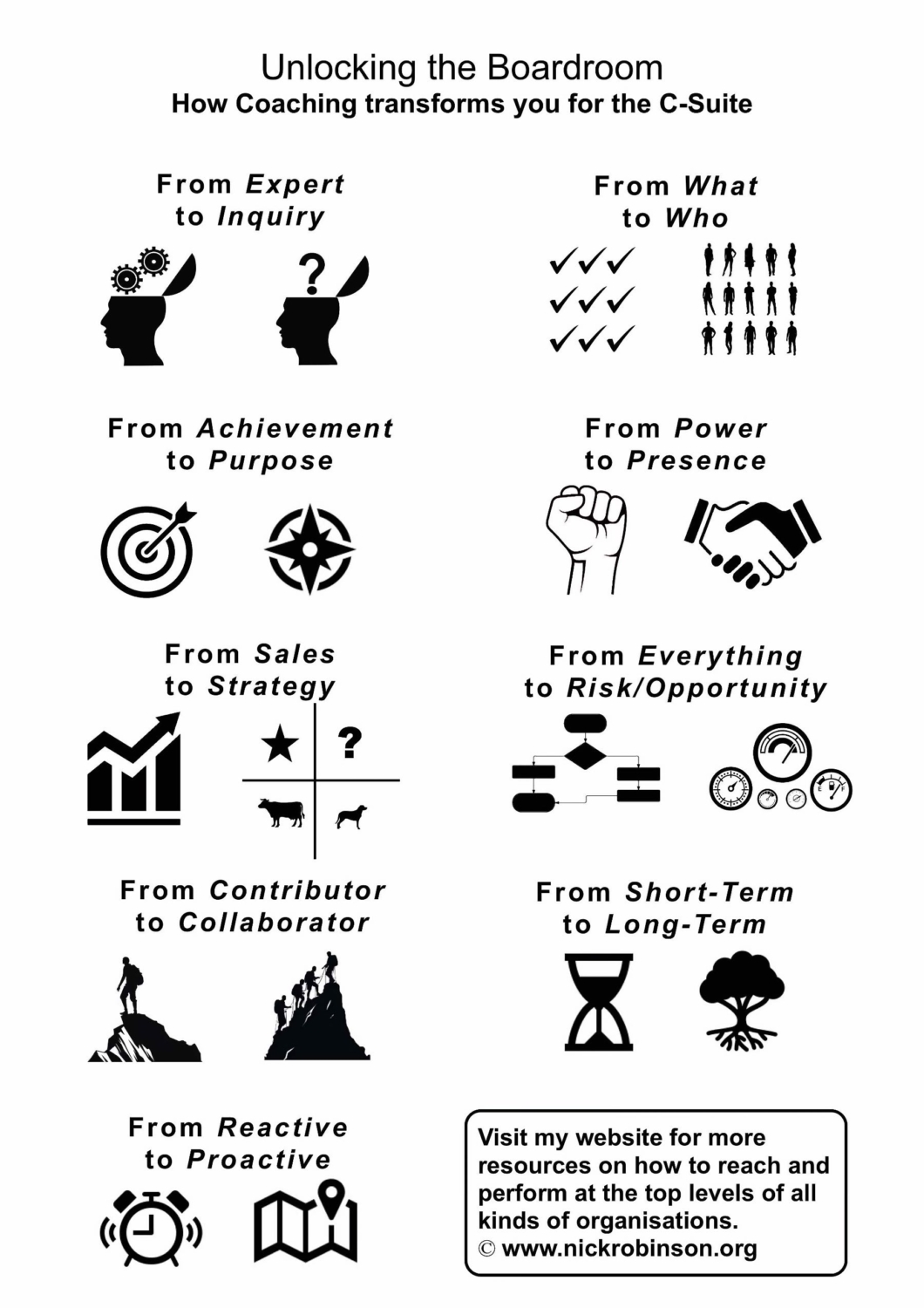
Unlocking the Boardroom: How Coaching transforms you for the C-Suite

Unlocking the boardroom isn’t just talent — it’s whole shifts in mindset. Discover the changes you’ll need to adopt to get into the C-Suite

[click the picture above and then right-click to download or save your free copy]

In today’s corporate world, talent alone won’t get you a seat in the C-Suite.

But here’s the real issue: neither will experience!

We shouldn’t be shocked at this. The landscape of leadership is changing, and clinging to old paradigms is a good way to get left behind.

It’s not just about what we know or who we know — it’s about how we think and adapt.

The best boardroom seats are reserved for those who embrace what’s needed: Transformative shifts in mindset and approach.

Want to know what it takes?

Here are the essential changes that all directors and chief officers should be working towards (with the help of their executive coach, of course) for that all-important first c-suite place in the boardroom:

From Expert to Inquiry

  • Shift from having to know everything to being part of the team that exercises mutual inquiry – asking yourselves the hard questions.

From What to Who

  • Change from knowing what needs to be done, to knowing the people who make things happen.

From Achievement to Purpose

  • Good managers do things right. C-suite board leaders make sure only the right things are being purposefully done.

From Power to Presence

  • Your responsibilities will now extend beyond your own department. You’ll need to go from exercising power and authority to cultivating presence and influence.

From Sales to Strategy

  • Even if you were never responsible for selling, you now need to make sure your whole organisation is strategically positioned to compete and be attractive in its marketplace.

From Everything to Risk/Opportunity

  • It’s no longer possible to be on top of everything. Shift from a digital mindset of managing it all to an analogue dashboard of risk and opportunity.

From Individual Contributor to Collaborator

  • Transition from being a sole achiever to harnessing the collective strengths and insights of your team, fostering a culture of collaboration and shared success.

From Short-Term to Long-Term Thinking

  • Move beyond immediate results and quick wins. As a C-suite leader, your gaze should be set on sustainable growth and crafting a legacy of long-term value.

From Reactive to Proactive

  • Instead of merely responding to the challenges that come your way, anticipate them. Lead with foresight, ensuring your organisation is always two steps ahead.

Overcoming the Barriers to Personal Growth

Our marketing director said I was aggressive and pushy.

It was a big slap in the face – mostly because I knew it was true, but thought I’d hidden it by being ‘nice’.

Once I got over the shock, it became one of the best bits of feedback I’ve ever had, starting a great period of personal growth.

But lots of barriers can get in the way of personal growth. Which is a shame, because all the important developments in our professional lives are built on it. It can be a practical, useful way to achieve what we want. Whether that’s a big promotion, more balance so that tasks and working relationships are easier and not such a slog, or the delivery of a significant project.


Here’s how to overcome the barriers to personal growth:

  • Seek Feedback
    It’s painful, but other people can sometimes see things that we can’t see or won’t acknowledge;
  • Look for Incongruence
    If you feel different on the inside to how you think you ‘ought’ to be on the outside, that’s a clue to what your personal growth might need to focus on;
  • Clear Outcomes
    Personal growth should be a useful, practical thing. What is it that you want to achieve?
  • Experiment
    Growth comes from trying out new ways of being; learning from what works and what doesn’t. Experiment with how you do and say things.

The key to overcoming the barriers to personal growth is to risk being vulnerable in order to discover something helpful.

How about you? What personal growth are you looking for - and what barriers are you finding? Share on X
A first-aid backpack on the ground in a forest setting with mountains in the distance. Used as a metaphor for applying the principles of Dr ABC to managing high-pressure decisions at work

The Dr ABC of Managing High-Pressure Decisions – an Emergency Response Guide

A while ago in preparation for some volunteering, I took one of the best training courses I’ve ever experienced, the Outdoor First Aid course at the UK’s national outdoor centre at Plas y Brenin.

Amongst other things, we learnt the Dr ABCDE structure of first aid.

And during a recent coaching session we used that structure to help manage a seriously high-pressure decision that my client was facing.

First, here’s a reminder of my notes from that course:


Dr ABCDE:

  • Danger: Ensure safety for yourself, bystanders, and the casualty from further harm.
  • Response: Check if the casualty is responsive or unconscious.
  • Airway: Check if the casualty’s airway is open and clear.
  • Breathing: Monitor if they are breathing normally.
  • Circulation: Look for signs of life such as pulse, movement, or coughing.
  • Disability: Check again for unconsciousness, possibly caused by a neurological injury or condition (e.g. check pupil response).
  • Exposure: Expose and examine them for other hidden injuries, and ensure they are not getting cold.

If you need to manage a high-pressure decision at work, here’s my first-aid guide, using the principles of Dr ABC and applying them to great leadership:

D – Danger – assess first before acting:

  • Assess the situation and potential risks before taking action.

R – Responsiveness – ask others for their response, seek allies and advice:

  • Seek input, feedback, and advice from others to gather different perspectives and insights.

A – Airways – open up your choices about how to deal with the high-pressure situation:

  • Explore a wide range of options and possibilities before narrowing down choices.

B – Breathing – monitor the progress and vitality of the decision-making process:

  • Continuously assess the progress, outcomes, and indicators of the decision to ensure it is on the right track.

C – Circulation – take decisive action and stay committed to the chosen course:

  • Follow through with the decision, implement it effectively, and dedicate the necessary resources and effort to make a significant impact.

D – Disability – evaluate the potential drawbacks and unintended consequences of the decision:

  • Assess and monitor the potential negative effects or limitations of the decision, and be prepared to address them proactively. Learn from what’s happening.

E – Exposure – identify hidden risks and protect against unfavourable external influences:

  • Be aware of potential risks or obstacles that may not be immediately apparent, and take measures to mitigate or avoid them. Protect the decision-making process from unfavourable external factors.

What else comes up for you, when you’re faced with managing a high-pressure decision at work? What do you need to take into account?

How do you manage high-pressure decisions and what can we learn from a first-aid approach? Share on X

Learning from Legends: Five Timeless Strategies for Goal Setting and Achievement

Discover goal-setting strategies from Einstein, da Vinci, Gandhi, Jobs, and Kahlo.
Whose footsteps will you follow?


Setting and achieving personal goals is a critical aspect of personal growth. But how do we go about it?

Let’s draw inspiration from some great minds, each of whom offers a unique perspective on setting and achieving personal goals.


1. Albert Einstein – The Power of Curiosity and Persistence

Einstein, a theoretical physicist known for developing the theory of relativity, was not particularly successful in his early schooling. However, his insatiable curiosity and persistence led him to become one of the most influential scientists in history.

His approach to goal setting might involve fostering a deep curiosity about the subject matter and persisting through challenges and failures.

To stand in Einstein’s shoes, cultivate a relentless curiosity and don’t let failure deter you from your path.


2. Leonardo da Vinci – Interdisciplinary Learning and Creativity

Leonardo da Vinci, an Italian polymath of the High Renaissance, was known for his unquenchable curiosity and feverishly inventive imagination.

His approach to goal setting might involve a commitment to lifelong learning, exploring a wide range of disciplines, and using creativity to solve problems and achieve goals.

To emulate da Vinci, embrace learning across a wide range of subjects and use your creativity to find unique solutions.


3. Mahatma Gandhi – Patience and Non-violence

Gandhi, the leader of the Indian independence movement against British rule, was a strong advocate for patience, peace, and non-violence.

His approach to setting and achieving goals might involve a commitment to peaceful methods, patience, and the belief that slow and steady progress can lead to significant change.

To walk in Gandhi’s footsteps, practice patience and believe in the power of peaceful persistence.


4. Steve Jobs – Vision and Innovation

Steve Jobs, co-founder of Apple Inc., was known for his visionary approach and his ability to innovate and think outside the box.

His approach to goal setting might involve having a clear, innovative vision of what you want to achieve and the determination to make it a reality, even if it means going against the grain.

To channel Jobs, hold a clear vision of your goals and don’t be afraid to challenge the status quo.


5. Frida Kahlo – Self-expression and Resilience

Frida Kahlo, a renowned Mexican artist, faced numerous health problems throughout her life. Despite her physical condition, she continued to express herself through her art.

Her approach to setting and achieving goals might involve using personal experiences as a source of inspiration, expressing oneself authentically, and demonstrating resilience in the face of adversity.

To embody Kahlo’s spirit, draw strength from your personal experiences and express yourself authentically in your pursuits.


These historical figures each offer a unique perspective on setting and achieving personal goals. Whether it’s Einstein’s curiosity, da Vinci’s interdisciplinary approach, Gandhi’s patience, Jobs’ vision, or Kahlo’s resilience, there’s a strategy here for everyone.

So, which approach resonates with you? Whose shoes will you choose to walk in as you set and achieve your personal goals? Share on X

The journey of personal growth is a marathon, not a sprint. Take the first step today.