Posts

Video: Dark Strategist – Difficult Person Type 2

Some of the most difficult people at work aren’t disruptive or emotional. Instead, they treat others like chess pieces, objects to be moved around in the dark, in service of a grand plan.

In this short video, I talk about the Dark Strategist, Type Two in The 9 Types of Difficult People.

Dark Strategists are often insightful and ambitious. They like having a clear plan and working behind the scenes to perfect it.

Problems start when the plan begins to matter more than the people. Colleagues can be moved around without consultation, information may be withheld, and decisions taken quietly without buy-in.

The impact is often people feeling manipulated, excluded, and undervalued.

You’ll also hear what helps. How leaders and coaches can role-model inclusive collaboration, and why remembering that the map is not the territory can make such a difference. I also touch on how to influence a Dark Strategist by speaking their language and engaging with the big picture, the strategy, and the wider business model.

With the right coaching, Dark Strategists can become powerful, insightful leaders that people actually want to follow.

Article: Scary Specialist – Difficult Person Type 1

Some of the most difficult people at work are difficult precisely because they’re so good at what they do. They deliver, they set the standard and they make it very clear when others don’t meet that standard.


In this article I’ll explore the Scary Specialist: type 1 in my 9 Types of Difficult People. I’ll look at:

  • The core pattern behind the Scary Specialist
  • The paradox at the heart of their behaviour
  • Practical ways to respond, whether you lead them or work alongside them


Who the Scary Specialist Is

The Scary Specialist is the expert who really isn’t afraid to let you know that they’re the expert.

These are people with deep knowledge and serious capability. They care about competence, pace, quality, and they set the bar very high for themselves and for everyone else.

At their best, they can really be the engine room of your business; driving results and driving success.


When it Starts to go Wrong

But things get difficult when anything threatens their ability to deliver.

That might be a weak process or a colleague who isn’t pulling their weight. Or a change that threatens their independence or threatens their control over their domain.

And when that happens, they become even more critical and even more demanding, and they will say exactly what they think no matter how brutally honest.


The Impact on Others

So you might notice people starting to tiptoe around them, or that new joiners to their department don’t last very long, and that other people start to leave the organisation because of them.

And this is the paradox, of course.

The Scary Specialist values competence above all else. But under pressure, their behaviour creates fear and silence and withdrawal in others.

And so the overall performance of the organisation, your organisational competency starts to suffer.


Leading a Scary Specialist

So if you are leading a Scary Specialist, you need to be very clear about any negative impacts they’re having.

Vague feedback or hoping they’ll somehow get nicer rarely works.

Above all, as a leader, you need to demand that your Scary Specialist continues to raise their level of competence. But not just their technical skills or their know-how, but also their competence in their own leadership and their competence in how they relate to other people.


Working with a Scary Specialist

If you’re working for, or alongside a Scary Specialist, two things really matter.

  1. Raise your own standards where you genuinely can. Become really good at your job. That’s all they really want from you;
  2. Be clear about your boundaries and be prepared to stand up for your boundaries.


Scary Specialists, respect, drive, and independence. So just tell them directly whenever their behaviour crosses some kind of a line for you. And the more direct you are in this, the more likely you are to get a good result from them.


At Their Best

At their best, Scary Specialists are not really scary at all.

They’re the experts whose drive and standards lift everyone around them.

But that only works, of course, when their expertise serves the whole organisation and not just their small patch of it.


About Me

I’m an executive coach helping leaders and senior teams turn challenging dynamics into great working relationships.

My first full-length book, The 9 Types of Difficult People, published by Pearson, is an Amazon and WHSmith best-seller. https://www.amazon.co.uk/dp/1292726067

My new flagship programme The Shift is a team development experience for senior leadership teams who sense they’re not yet working well enough together, maybe not firing on all cylinders, even if no one has said it out loud. https://www.nickrobinson.org/the-shift-leadership-team-development


Video: The Rock Difficult Person Type 8

That “stubborn” colleague slowing everything down? They’re not blocking progress – they’re protecting the foundations.

Meet the Rock – Type 8 in The 9 Types of Difficult People

Rocks are the calm, steady figures who keep everything running smoothly… until change threatens the stability they’ve built. Their resistance isn’t negativity – it’s caution born from responsibility.

In this short video, I explain:

🎯 Why Rocks hold back when others want to move fast

🤝 How to earn their trust and turn them into allies

🏗 The leadership moves that make progress possible without breaking what already works.

You’ll learn how to lead through trust, not pressure – and how to build teams that balance safety with change.

From my book The 9 Types of Difficult People – helping leaders and teams turn challenging dynamics into great working relationships.

The Rock: Difficult Person Type 8

If you have a colleague who is not moving a project forward and it feels as if you have hit solid granite, nothing budging no matter how hard you push, that is a Rock. Type 8 in my 9 Types of Difficult People.

On the surface, a Rock is usually calm, dependable and unshakeable. Underneath, they’re gripping the foundation so tightly that nothing can shift until they are convinced it is safe.

And this is where the problems start. Progress slows, deadlines slide, and everyone else wonders why everything takes so long!


What’s Really Going On

Rocks have an instinct for how everything fits together. They see the invisible plumbing of an organisation: all the connections and dependencies.

They worry that if one valve is turned too quickly, something somewhere else will burst. Their resistance is not laziness and it’s not awkwardness. It’s fear that something important will break.


Good Foundations – But No Building

I once worked with a Rock who was responsible for a key operational system. Whenever the leadership team launched a new project, he would nod, take the papers and then disappear for weeks.

When I asked how things were going, he would say: “Oh, it’s all fine; we’re tidying up the old database first.”

What he really meant was: I am making sure the foundations are solid before I build on top. The problem was that no one else knew progress wasn’t happening!


If You’re Leading or Coaching a Rock

The worst thing you can do is treat their caution as negativity. Instead:

  • Show that you understand the risks they are guarding against
  • Demonstrate your own sense of responsibility; that you’ve also thought through the consequences of what’s going on
  • Involve them early in the planning process, so that you can ask them what they think could go wrong; and
  • Make sure you listen properly to their concerns

Once they know you value their foresight, they will shift from blocker to ally.


When You’re Working with a Rock

Persuasion works best when it is framed as problem avoidance.

  • Don’t say: “We need to do this to innovate.”
  • Do say: “We need to do this now, so it doesn’t cause bigger problems later on.”

If you speak their language of prevention and continuity, they will often quickly get on board.


If You Report to a Rock

Remember that Rocks often hold themselves and their teams to very high standards. They will put in long hours keeping everything running smoothly and will expect the same from you.

It helps to:

  • Set clear boundaries early, at the same time as …
  • Showing you are dependable
  • Making sure you don’t let their workload quietly swallow yours.


When Rocks Are at Their Best

They are the calm centre of the storm: solid, consistent, trusted by everyone.

They:

  • See how the moving parts connect
  • Anticipate problems before they appear
  • Give organisations the stability that allows real progress to happen

When you recognise that and include them properly, Rocks stop being barriers and become the foundation of lasting success.


About me

I am an executive coach helping leaders and senior teams turn challenging dynamics into great working relationships. I coach and write about how senior leadership teams can fulfil their potential and how leaders and managers can deal with difficult relationships and people at work. My first full-length book, The 9 Types of Difficult People, published by Pearson, is an Amazon and WHSmith best-seller.

If you or your team might need coaching support, please get in touch.


Video: The Scary Specialist – Difficult Person Type 1

Ever worked with someone who gets results, but people keep leaving because of them?

This video looks at the Scary Specialist: the expert whose constant criticism and blunt honesty drive capable people out of the organisation.

In this video, I explore:

  • How their relentless criticism creates fear and silence
  • Why good people stop speaking up, disengage, or leave
  • The hidden cost of “brilliant but brutal” behaviour
  • What leaders must confront when expertise comes with a human price

Scary Specialists care deeply about standards. The irony is that their behaviour often destroys the very competency they value most!

For more on how to turn challenging dynamics into great working relationships, look out for my book The 9 Types of Difficult People, follow me here, or get in touch for more coaching and support.

The Revolutionary – Difficult Person Type 5

If you’re working with someone and it feels like you’ve grabbed a tiger by the tail, you might have a Revolutionary on your hands.

The Revolutionary is Type 5 of my 9 Types of Difficult People.

Revolutionaries bring passion and audacity in big doses. They know that to change one thing you often need to change three others first, and that you cannot make an omelette without breaking eggs.

Revolutionaries bring passion and audacity in big doses. They know that to change one thing, you often have to change three others first, and that you can’t make an omelette without breaking eggs.

But that drive to change everything, and to do it fast, can cause problems at work:

  • They often go too far and end up treading on people’s toes.
  • They can move so quickly that they risk burning themselves—and their allies—out.
  • They grasp new systems and connections at speed, but don’t always see that others need time to build consensus.

If you are leading a Revolutionary, be sure you really want that tiger by the tail, and be ready to clear the path for them and repair relationships along the way. With the right leadership they can become truly transformational – watch this video to find out how.

Video – Boundaries at Work

Video – Difficult Conversations at Work

How to Stop Being a People-Pleaser at Work – My Book in Stylist Magazine

More great coverage of The 9 Types of Difficult People in the press, including this super article in Stylist Magazine on How to Stop Being a People-Pleaser at Work

Here’s some of the highlights from the article, which I’ve linked in full below.

🔍 Acknowledging the Issue
Realising that being a people-pleaser can hinder your professional growth in quite a few different negative ways.

📝 Preparing for Difficult Conversations
Techniques for handling those necessary but challenging conversations effectively.

🚫 The Art of Saying ‘No’
Strategies to assert your needs and priorities without adding to the conflict, so enabling healthier workplace dynamics.

💪 Reclaiming Your Power
Emphasising the importance of authentic communication and setting boundaries for personal and professional development.


Click here for the full article in Stylist Magazine.


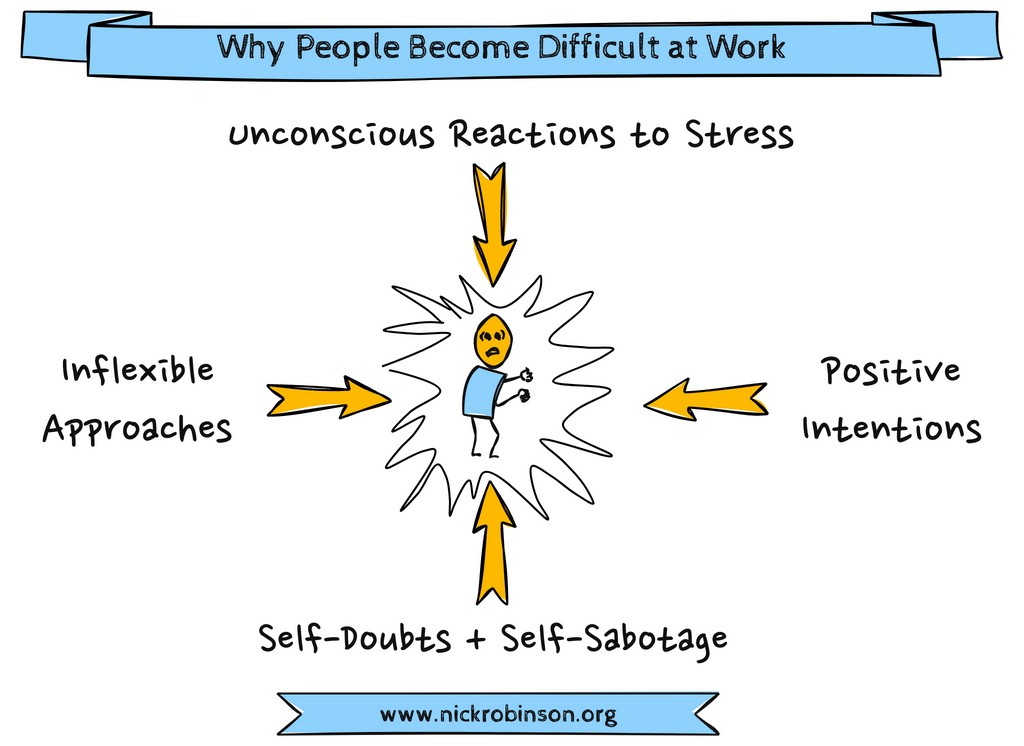
Why People Become Difficult at Work

Ever experienced someone being really difficult to get on with at work, and wondered WHY?

There are four key reasons:

  1. Unconscious Reactions to Stress
    They’re reacting to what’s going in inside the organisation and its operating environment (and it’s likely there are things beyond their control that the organisation itself needs to fix)
  2. Positive Intentions
    They’re trying to achieve something but are having the wrong impact
  3. Self-Doubts and Self-Sabotage
    Their own thought-processes are piling on more pressure and more rigidity in how they behave
  4. Inflexible Approaches
    They’re not switching the focus of their intentions to suit the people and circumstances around them.

When things aren’t going smoothly, if we can understand what’s behind the way someone behaves at work, it makes it much easier to help them and others to get along well together.

There’s still a lot to do, and it’s important not to jump to blaming or shaming. But understanding Why can be a crucial first step.


To discover more practical tips and strategies for dealing with a difficult person and quickly improving workplace relationships, please check-out my book The 9 Types of Difficult People or explore more of the articles and resources on this website.