Shame at Work – Definition

The Seven Self-Limits

We all have a set of unconscious Self-Limits that restrict what we say and do at work.

They’re intended to help keep us safe. To stop us from doing or saying anything which might make us look stupid, bite off more than we can chew or annoy the people around us. Most of the time they’re helpful, moderating our behaviour so we can get on with others and not over-stretch ourselves.

But at other times, the Self-Limits can really get in the way of what we actually want to achieve. Holding us back, making us try too hard in the wrong ways, and sucking the joy out of what we do get done!

Shame is one of those Self-Limits.

Shame

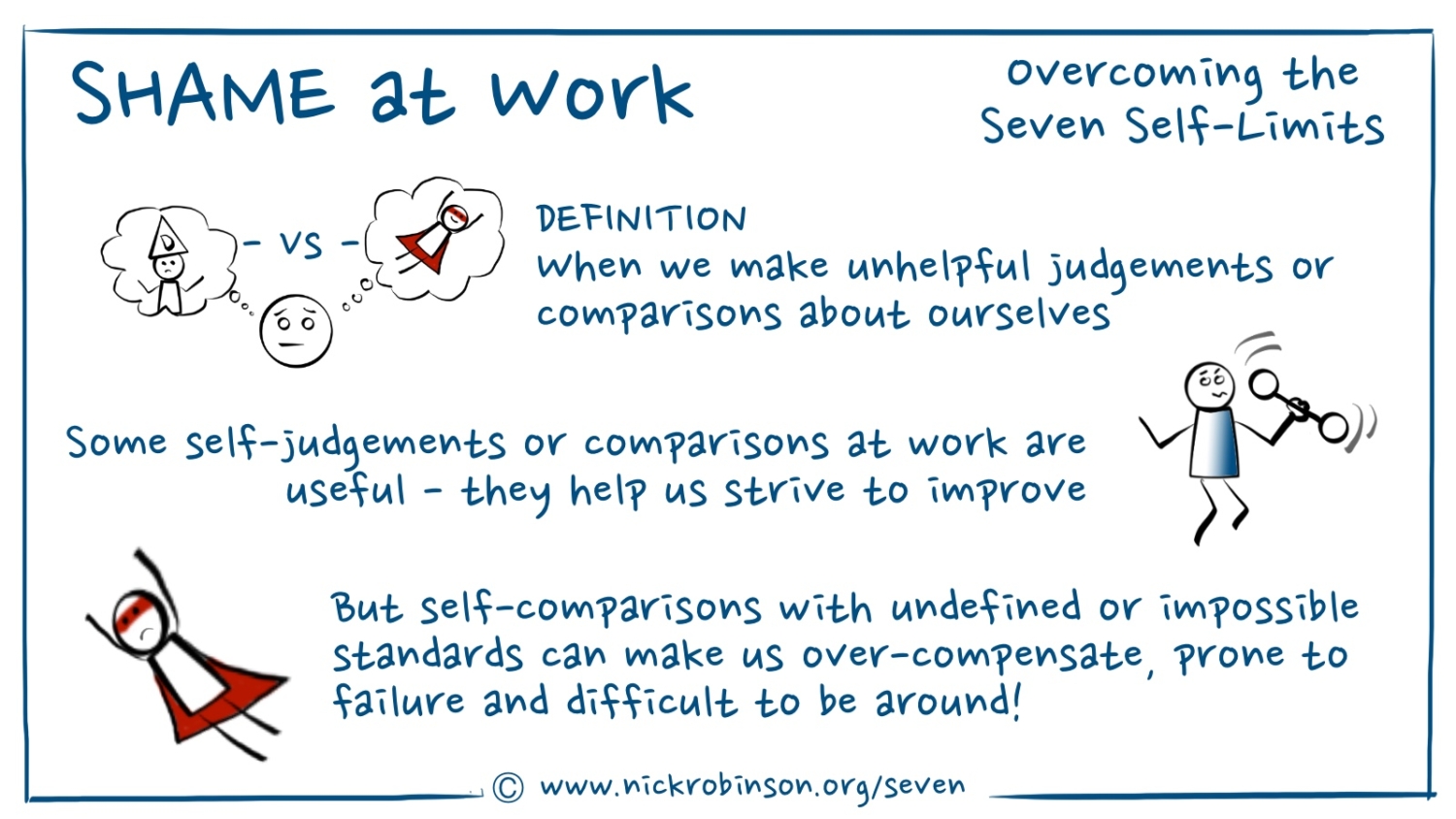
Shame is when we’re making a judgement or comparison about ourselves that is unhelpful.

Now, not all self-judgements or comparisons are unhelpful – some are useful. For example, if I notice that my failure-rate at a specific task is higher than other people’s failure rates, I can start to look at what might be causing it. And see if I can improve.

Unhelpful self-judgements or comparisons

But unhelpful self-judgements or comparisons are when I compare my self to a standard I haven’t defined, and then regard myself as ‘bad’ or a failure for not having reached that standard.

Instead, I just tell myself:

I’m not good enough

or

If only I was better

And instead of helping me to progress I might over-compensate. Putting too much effort into the wrong priorities or trying too hard just at the wrong times. And when effort goes in the wrong direction that can paradoxically lead to failure anyway. Shame also tends to rub-off on the people around us in the wrong way. Either our shameful judgements about ourselves mean that we don’t contribute to the team in a positive and helpful way. Or we can start to look at other people the same way  – “I’m not good enough – and neither is he!”

The Way out of Shame

As with all the Self-Limits, to first step to overcoming the negative parts of shame is to become much more aware of it. And I’ll cover recognising shame in the next couple of articles.

Look out for more in this series using the link at the top of this page.

Trust yourself.

Recognising Self-Doubt at Work

The Seven Self-Limits

In the professional world, we all have a set of mental Self-Limits that unconsciously restrict what we do and say. Their purpose is to keep us safe – to stop us from saying or doing risky, stupid, or embarrassing things. But they can also have a really strong tendency to hold us back from reaching our full potential, especially when it comes to achieving goals and building effective working relationships.

Self-Doubt

Self-Doubt is one of these limits, and learning to recognize it is crucial for success at work.

We must become more AWARE of its impact, how it feels, and the inner self-talk that accompanies self-doubt in professional situations.

Here’s what Self-Doubt looks like in the workplace:

Impact

  • Self-Doubt causes hesitation, avoidance, procrastination, and can lead to the failure to complete crucial tasks or projects.

Emotions

  • In the workplace, Self-Doubt feels like anxiety, insecurity, or uneasiness; it may manifest as a knot in our stomachs or a weight on our chests.

Self-Talk

  • If you’re experiencing self-doubt at work, you might think, “I can’t do that [task]” or “I won’t be able to [succeed in this role]”

Overcoming Self-Doubt at Work

There are four steps to overcoming each of the Seven Self-Limits. First, practice raising awareness of it, noticing when it occurs to stop it from being an unconscious event. Then, Analyze why it’s happening; Accept when it might be useful; and decide what Action to take to continue progressing.

Try it for Yourself

Next time you notice any of the Impacts, Emotions, or Self-Talk mentioned above in your working experience, make a note of it. Keep practicing awareness because recognising self-doubt is halfway to overcoming it.


Stay tuned for more articles about overcoming each of the seven self-limits, using the menu at the top of the page.

Trust yourself

The Three Levels of Awareness

Awareness is the first step towards overcoming all of the Seven Self-Limits

We can practice raising our awareness of:

  • Impact – are we held-back, putting things off, too critical, too aggressive, etc? What happens because of the impact of our Self-Limits?
  • Emotions – are we anxious, angry, frustrated, bored, powerless, etc? What feelings are an indication of our Self-Limits?
  • Self-Talk – what criticisms, doubts, judgements, etc, do we say to ourselves?

Look out for the other posts in this series, which will cover each of the Seven Self-Limits, including:

  • Self-Doubt – When our confidence is too shaky
  • Shame – When we make unhelpful judgements or comparisons about ourselves
  • Self-Criticism – When we think that we have to be or do things in a certain way
  • Self-Sabotage – When our unconscious thoughts can stop us before we’ve even started
  • Guessing – When we unhelpfully guess at what other people think, feel or mean
  • Blaming – When we give away some of our power or authority by declaring that somebody or something else is the cause of something undesirable
  • Exaggerating – When we imagine it will all go wrong or be bad, every time

As well as the four steps to over-coming each of the limits:

  1. Awareness
  2. Analysis
  3. Acceptance; and
  4. Action

Ep. 5. Overcoming Self-Doubt – Step 1: Awareness

Start overcoming Self-Doubt and boosting confidence with the crucial skill of Awareness

Here we’re looking at raising Awareness of Self-Doubt, as the first step in overcoming it.

Self-Doubt is a good example of the problems caused by the Self-Limits.

It’s when our confidence in ourselves is too shaky. When our Self-Doubt has gone beyond the point where it’s a useful check or balance and is now actually getting in the way of things that are important to us.

Here’s how to get free of that by raising awareness of the process.

Ep. 4. Brief Intro to each of the Seven Self-Limits

Meet the Seven!

The point of this programme is to help deal with things like procrastination, imposter-syndrome, confidence-dips, self-sabotage and avoid massive over-reactions when you’re facing a big challenge at work.

Here’s a quick overview of each of the Seven types of Self-Limits. Includes some guidance on internal dialogue, emotions and other issues to help raise awareness.

3. Why the Seven Self-Limits might stomp on your attempts to change!

A couple of extra tips that will help before we dive in

The point of this programme is to help deal with things like procrastination, imposter-syndrome, confidence-dips, self-sabotage and avoid massive over-reactions when you’re facing a big challenge at work.

Here’s a few more tips before we dive in and some warnings about the self-limits that might try to stomp on your attempts to change and improve things!

2. How to use this Programme

If there’s one thing that I almost always cover with my coaching clients, it’s this tool – Overcoming the Seven Self-Limits.

Here’s how to make it work

If there’s one thing that I almost always cover with my coaching clients, it’s this tool.
This is a crucial part of understanding ourselves and being able to manage ourselves.

And self-knowledge and self-management are the foundations to our emotional intelligence.
They enable us to focus on the tasks we need to accomplish and on building the good relationships we need to succeed at work.

So in this programme I’ll give you the tools to do just that.
In future videos we’ll work though each of the Seven Self-Limits in turn and see how to overcome them.

You can dip in and out of these videos however you want. Each has an exercise and some tools that will help.
Or you can watch them in sequence, building up the core skills of Awareness, Analysis, Acceptance and Action as you go.

1. Introduction

Introduction to the Video Programme – Overcoming the Seven Self-Limits

We all have a collection of mental Self-Limits that put unconscious restrictions on what we say and how we behave. They’re like a double-check on what we might do. Or like an emergency brake on what we might accidentally say. Most of the time these Self-Limits are useful. They stop us from looking stupid. They keep us from biting off more than we can chew. And they make sure we don’t say or do something to annoy people or to damage our status.

But when we want to make an important change at work, or when we need to get something difficult done, and especially if we’re already under pressure, the Self-Limits have a strong tendency to really hold us back. They can make us second-guess ourselves. Or worse, they can make us actually fail.

My name is Nick Robinson and this video is the introduction to my programme, Overcoming the Seven Self-Limits.

3 Handy Ways to Avoid Doing Great Delegation (Part 1/3)

This is the first of three short posts with some handy tips for avoiding the dangers of doing half-way decent delegation – and of being seen as vaguely competent and therefore deserving of yet more responsibility, stress and leadership burden at work!

TIP 1️⃣: Never start by describing the OUTCOME that you want to achieve.
🧭 This tip is almost too easy; starting with the Outcome is surely just a backwards way of doing things and risks having way too much clarity and direction. Better to get going with the first step that comes to mind and only then figure out where you’re going, and why, along the way. People will thank you for not overloading them with this kind of focus. 🗺

TIP 2️⃣: Always tell people HOW they should do the thing you’re delegating to them.
🔬 This is where a lot of managers go wrong, by imagining that people might have their own way of doing things. Or even, that they might come up with a better way than you had thought of. That kind of thinking is just ridiculous! It’s much safer – and offers much more scope for subsequent micro-managing – if you treat people like robots and tell them EXACTLY how you would do the thing you’re delegating to them, if only you had time to do everything. 🤖

TIP 3️⃣: Don’t offer SUPPORT or set out a process for check-ins and coaching along the way.
⛑ If they need support, what’s the point of delegating in the first place – might as well have done it yourself! If only you had the time; or the effort. Anyway, whatever, the kind of structured check-ins and coaching that supports somebody as they try a task for the first time, or learn to stretch themselves, is soooo demanding of your attention. It is boring. Please people, just go away and get on with the thing I told (sorry, asked) you to do, in the way I said to do it. Just tell me when it’s done. Whenever that is; did we agree a deadline; I forget … 🏖

If any of this strikes a chord, please check out my possibly helpful ebooklet on Amazon:


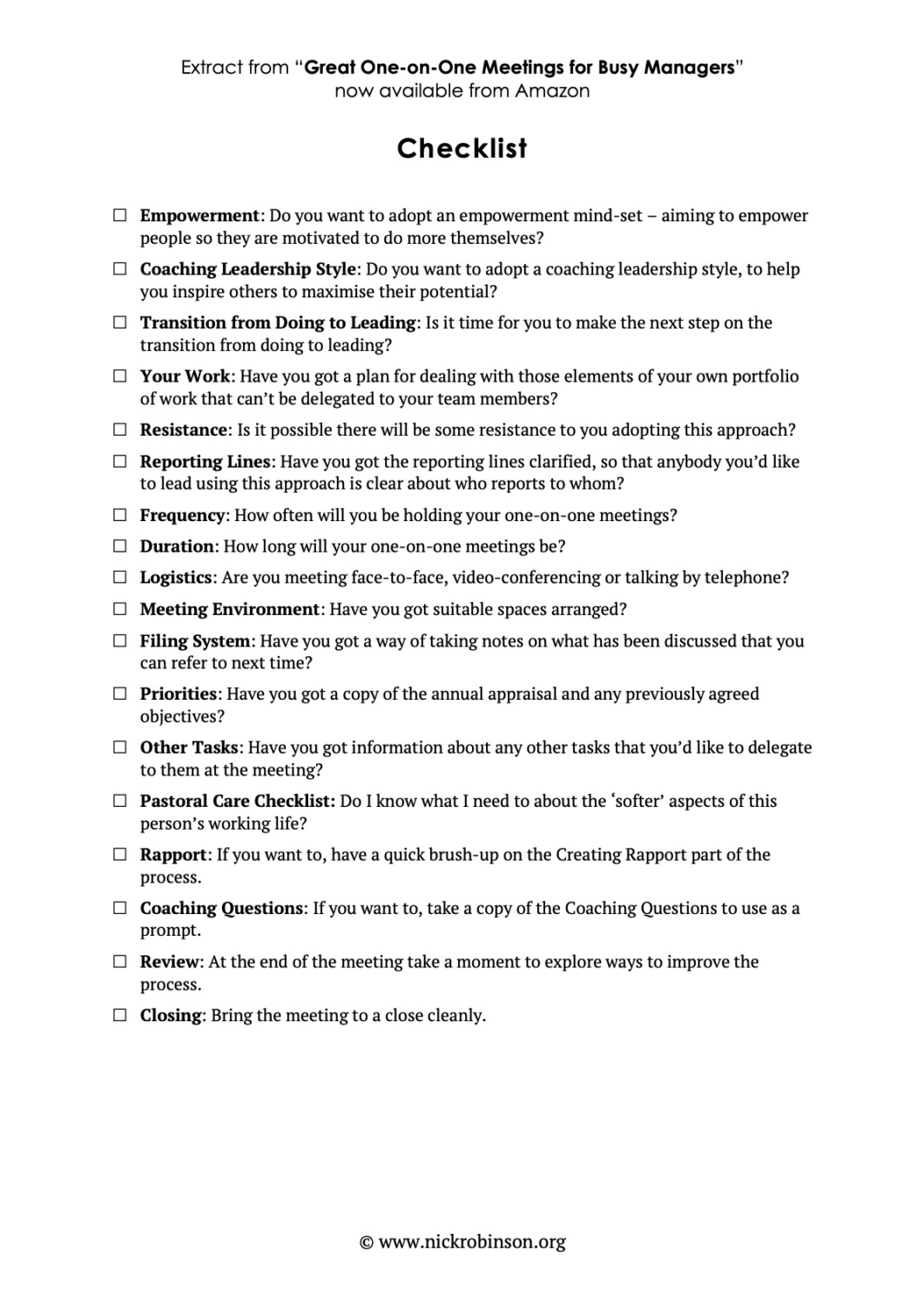
Checklist for leading one on one meetings

This is the second in a series for people who want to use one-on-one meetings as a great tool for leading the efforts of their team members

A structured but flexible one-to-one meetings approach is probably the best way you’ll find for managing and motivating the work of your individual team members. But sometimes it isn’t easy to know how to go about doing that effectively, or to make sure that it will get the results you’d want – such as switched-on and fulfilled team members and tasks that get done well and on time.

If you right-click the image above and then select “Save as…” you can download your own copy of the checklist.

Life as a manager can often be very busy and quite complicated, so if that’s the case for you – use this checklist as a way of getting started, in this order:

  1. Take stock of which items on the checklist you already have in place or already know the answers to?
  2. Once you’ve done that, which is the most straightforward item on the checklist for you to work on next?

If you need more information, you can read the rest of the tips when published here. They’re essentially a summary of my short ebooklet.

Or go ahead and grab your copy from Amazon here – free to Kindle Unlimited members or otherwise £1.99

I wrote that short ebooklet when, in the space of a fortnight, three separate coaching clients mentioned that they were struggling a little with running their one-to-one meetings with their individual team members. It’s easy to cover those kinds of issues in a coaching session, but it seemed to me that it would make better use of my clients’ time in our sessions if I could also just give them some simple guidance to take away and use as and when they wanted. I hope that the booklet has been useful – it’s been slowly working its way up the independent management books charts anyway. The next in the series will cover Delegation.


What’s essential for you, when running your own one-on-one sessions with your team members? Either leave a comment below if they’re still open at the time of reading, or tweet me @nickrobcoach.

Download a free copy of this useful checklist for running great one-on-one meetings with your team members. No sign-ups etc required #leadership #management. Share on X