Posts

Checkmate – why your brightest colleagues try to keep you in the dark

In the chess game of work there’s a player who is often several moves ahead.

It’s the Dark Strategist 🤯

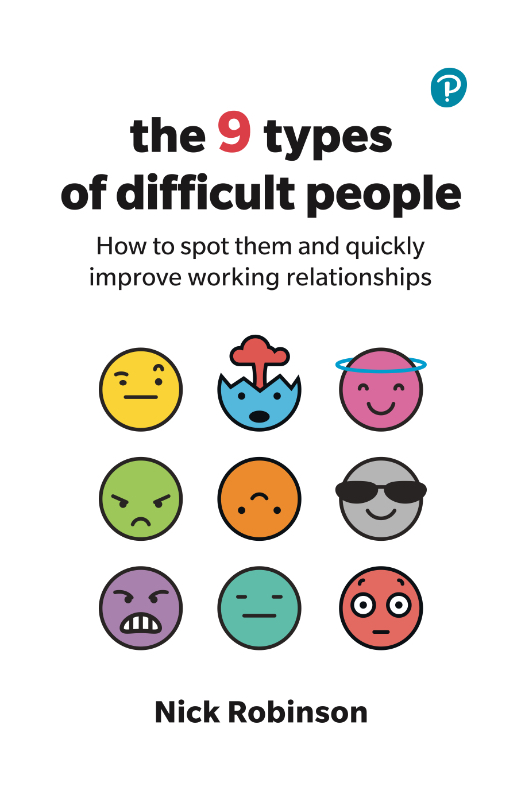
Featured in my book, The 9 Types of Difficult People, the Dark Strategist is someone who will treat others like chess pieces, to be moved around to deliver an ambitious grand plan.

It’s often just too slow, too tedious and too outside their comfort zone to explain, coach and collaborate with you instead.

But even though they’re smarter than average their approach can be flawed, with important details overlooked. And they can sometimes let a perfect concept be the enemy of a good execution.

However positive their intention, whether it’s steering the company through a crisis or grabbing an opportunity no-one else has spotted, they can leave people feeling manipulated and undervalued. So that, in the end, nothing actually gets properly done.♟️


💡 Here are some of the main tips from my book about how to throw some light on your dealings with a Dark Strategist and quickly improve working relations, whether you’re their leader, a colleague, or a team member. Or just someone who wants to help them stop being quite so difficult!

🌏 As their leader, if you can speak their language – big-picture, strategic-thinking – that’s sometimes enough to coax them out of the dark and towards a rounder approach. Treating people as people and managing concrete tasks as well as abstract strategy.

🤝 As a colleague or a team member of a Dark Strategist, you’ll also need to learn how to co-strategise, connecting your own knowledge and goals to the wider vision. This will keep them connected long enough for you to join in the big chess game too.

♟️ If you don’t do this, you’re likely to get treated as a chess piece yourself. Call this out, and don’t tolerate they’re treating you like an idiot, just because you don’t also start from a big-picture assessment of things. Collaboration is the key to a successful workplace, and doing that well depends on a good variety of skills and approaches.


In the next of these articles I’ll be taking a look at a different type of difficult person at work. Someone whose positive qualities and strong principles can themselves be the cause of problems.

And to see all of the types I’ve covered so far, or to grab a copy of my book, check out the tags below and/or the links to in the sidebar.

Worst Enemy at Work – or Best Ally? How to thrive alongside a Scary Specialist 🤨

Ever found yourself working with or for a Scary Specialist?

You know the type – brilliant, indispensable, but SO challenging to deal with! They’re the ones who know everything about a particular topic, and they’re not afraid to let you know it.


So, how do you turn this potential ‘worst enemy’ into your ‘best ally’?

Here’s the four steps you need to follow:

1️⃣ Raise Your Own Game

  • Step up your skills and knowledge. The Scary Specialist respects competence. Demonstrate your own commitment to excellence, and they’re more likely to see and respect you as a peer.

2️⃣ Speak Up, Don’t Suffer in Silence

  • If there’s an issue, voice it. Scary Specialists can be intense, but they also respect honesty and directness. Approach them with clear, constructive requests for what you want.

3️⃣ Boundaries Are Your Best Friend

  • It’s crucial to establish what you will and won’t tolerate. Be clear about your limits and communicate them confidently. Scary Specialists appreciate those who stand their ground.

4️⃣ Stay Connected

  • Keep building relationships within your team and the broader organisation. It not only prevents isolation but also offers you a wider perspective and support network.

Remember, a Scary Specialist doesn’t have to be your nightmare at work.

With the right approach, they can become an invaluable ally, helping you to new heights in your career.

📘If you want to go deeper into navigating workplace dynamics with various challenging personalities, please check out my new book, ‘The 9 Types of Difficult People’, recently published by Pearson and now in the WHS top 10 business books list. Look for the links below or in the sidebar.


And in my next article I’ll be looking at the type of difficult person closest to my own approach – the Dark Strategist 🤯

Mastering the Challenge of the Scary Specialist

The scariest person I ever worked for was a former UK table-tennis champion, then my regional GM.

She had a habit of giving you the hair-drier treatment at the same time as eating a crusty cheese roll. And I was struggling with a new appointment to an under-performing division.

We both knew what needed to be done. But the problem for me was how far and how fast that could happen. Not far or fast enough I realised, in between dodging the crumbs!


Nowadays I really like working with scary specialists like her.
🚀 Why NOT focus on being competent and driven and delivering the best that you can.

🛑 But what I also know now that I didn’t know back then, is that the hair-dryer approach isn’t always the best way of GETTING to that high-delivery place.

And there can also be a lot of collateral damage around a scary specialist. Good people won’t tolerate feeling threatened, belittled or locked-out for long – and will leave. Leading to a spiral of declining performance.

❓Who is or was the scariest person that you ever worked with?


❓And what should you do if you’ve got a scary specialist in your organisation?

Collateral damage is happening and performance isn’t improving. You might be tiptoeing around their threats while being told, “Go away; I’ll sort it!”

Focus on these three points:

  1. Sometimes, leaders of a scary specialist might find that their skills and competences are so essential that you need to ensure they only ever have the best people and the slickest of support functions around them.
  2. But more often, leaders will need to also become a little scarier themselves in this situation. To demand that this person develop new ways of managing – or else.
  3. Use their desire for competence to help. Demand that they develop skills which can also take their people from zero to 100. Not just manage well with an already high-functioning team.

If you’re working alongside or below a scary specialist, it can be an interesting experience! In my next article, I’ll look at issues around defending boundaries, raising your own game, and not becoming isolated in the process.

📚 For more insights into dealing with a scary specialist, please check out my book, The 9 Types of Difficult People. See the links below or in the sidebar.

And in the meantime – keep dodging those crumbs!

Maximising the Impact: How to Use ‘The Nine Types of Difficult People’ Effectively 📘

Improving workplace relationships can be tricky, especially when dealing with challenging personalities!

My book, ‘The Nine Types of Difficult People‘, is designed to be your guide through this maze. But how can you get the most out of it?

Here are some tips:

🔍 Understand the Layout

  • Chapter Two is Your Starting Point: It sets the foundation for the rest of the book. Start here to quickly understand my overall approach and how to apply it.
  • The Matrix of Difficult People: Took a look at this tool in the early chapters. It’s crucial for identifying and understanding the different types you might encounter.

🤔 Reflect on Your Situation

  • Identify Your Difficult Person: Use the matrix and descriptions to help pinpoint the type of difficult person you’re dealing with.
  • Context Matters: Consider your role in relation to the difficult person – are you their leader, colleague, or team member?

📝 Apply the Strategies

  • Tailored Approaches: Improving relationships works best with the right strategy. Find the chapter that corresponds to your identified type and explore that.
  • Practical Tips and Tactics: Implement the suggested strategies in your day-to-day interactions.

🔄 Iterate and Adapt

  • Not a One-Time Read: Your first pass through the book is great beginning and often leads to some useful quick-wins. Return to the relevant sections as your situation evolves.
  • Stay Flexible: Be prepared to adjust your approach as you learn more about the individual and the dynamics involved.

🔗 Connect the Dots

  • Beyond the Individual: Use the insights from the book to enhance the overall team dynamics and culture in your workplace.
  • Share Your Learnings: Discuss concepts from the book with colleagues to help build a more understanding, collaborative and effective working environment.

Dealing with difficult people is both a mindset and a skillset that can be easily developed. My book is here to guide you, and the real change happens through your application of these strategies in the real world.

Let’s make work a place where everyone can be at their best!

Beyond the Monster Myth: Unraveling the Mystery of Difficult Leaders

The more people I spoke to about this leader, the more worried I got:

🔴 “Extremely difficult, scary and obstructive!”

🔴 “The department is haemorrhaging staff and managers.”

🔴 “Every time we try to change something, he blocks it!”

🔴 “You are literally our last attempt before we look at dismissal.”

By the time our first coaching session came around I was expecting to meet something of a monster.


But what I found was very different.

It seemed to me that here was a baffled and bewildered person. Someone in a demanding role, in challenging and shifting circumstances, trying their best to get good outcomes for their department’s clients. In the only way that they knew how.

As well as a slight concern that I was being played by this person, I left with lots of questions. How could there possibly be such a massive gap between what I thought – and the hugely negative experiences that other people were having? In the end, we coached together for six months and created some very positive change.

I got so curious about what was going on to create this kind of situation to start with that I ended up writing my first full-length book about it – The Nine Types of Difficult People.


If you’ve ever wondered how it could easier to help a difficult person themselves, or how the people around them can deal with what’s going on as quickly and effectively as possible, please check out the links below to discover more about the book and look around this website for other resources.

Grab yourself a copy at any good bookshop or online using these links:

Amazon:
https://www.amazon.co.uk/dp/1292726067

WH Smiths:
https://www.whsmith.co.uk/products/the-9-types-of-difficult-people-how-to-spot-them-and-quickly-improve-working-relationships/nick-robinson/paperback/9781292726069.html

Waterstones:
https://www.waterstones.com/book/the-9-types-of-difficult-people-how-to-spot-them-and-quickly-improve-working-relationships/nick-robinson/9781292726069

Crumbs! I’ve only gone and had a book published …

Even though it’s been a massive part of my work for years now, deciding to write a book about how to deal with *difficult people* wasn’t easy.

My take is that almost everybody we find difficult is someone trying to do their best, in a situation they find very challenging, in what is often the only way they know how. So if you want to make a difference in that situation it has to involve a lot of soft compassion 𝒂𝒏𝒅 hard constructive challenge.

And that’s why I was so grateful to win the support of my agent Kizzy Thomson, editor Eloise Cook and the rest of the fantastic team at Pearson, who all really got what the book was about and the approach it needed to take.

Thank you to supporters, pre-publication reviewers and everybody who helped me over the last three years of putting this together. Individual thanks and copies are heading out as soon as.

The presses are rolling and my hope now is that a copy of my book drops into the hands of someone who needs it just at the right time.

Grab yourself a copy at any good bookshop or online using these links:

Bookshops:

Amazon:
https://www.amazon.co.uk/dp/1292726067

WH Smiths:
https://www.whsmith.co.uk/products/the-9-types-of-difficult-people-how-to-spot-them-and-quickly-improve-working-relationships/nick-robinson/paperback/9781292726069.html

Waterstones:
https://www.waterstones.com/book/the-9-types-of-difficult-people-how-to-spot-them-and-quickly-improve-working-relationships/nick-robinson/9781292726069

Work-Life Balance is for the HR wimps

Work-Life Balance is for the HR wimps.

Here are three lessons from my successful coaching clients on how to really master it:

1) Passion First:
When you’re in love with your work, 2am might just be your healthy prime time.
Go for it.

2) Own Your Role:
Burnout isn’t about too much work; it’s about too little control over your decisions and results.
Seize your power.

3) Colour outside the lines:
People with interests and commitments outside work find it much easier to put work aside.
Paint your own canvas.

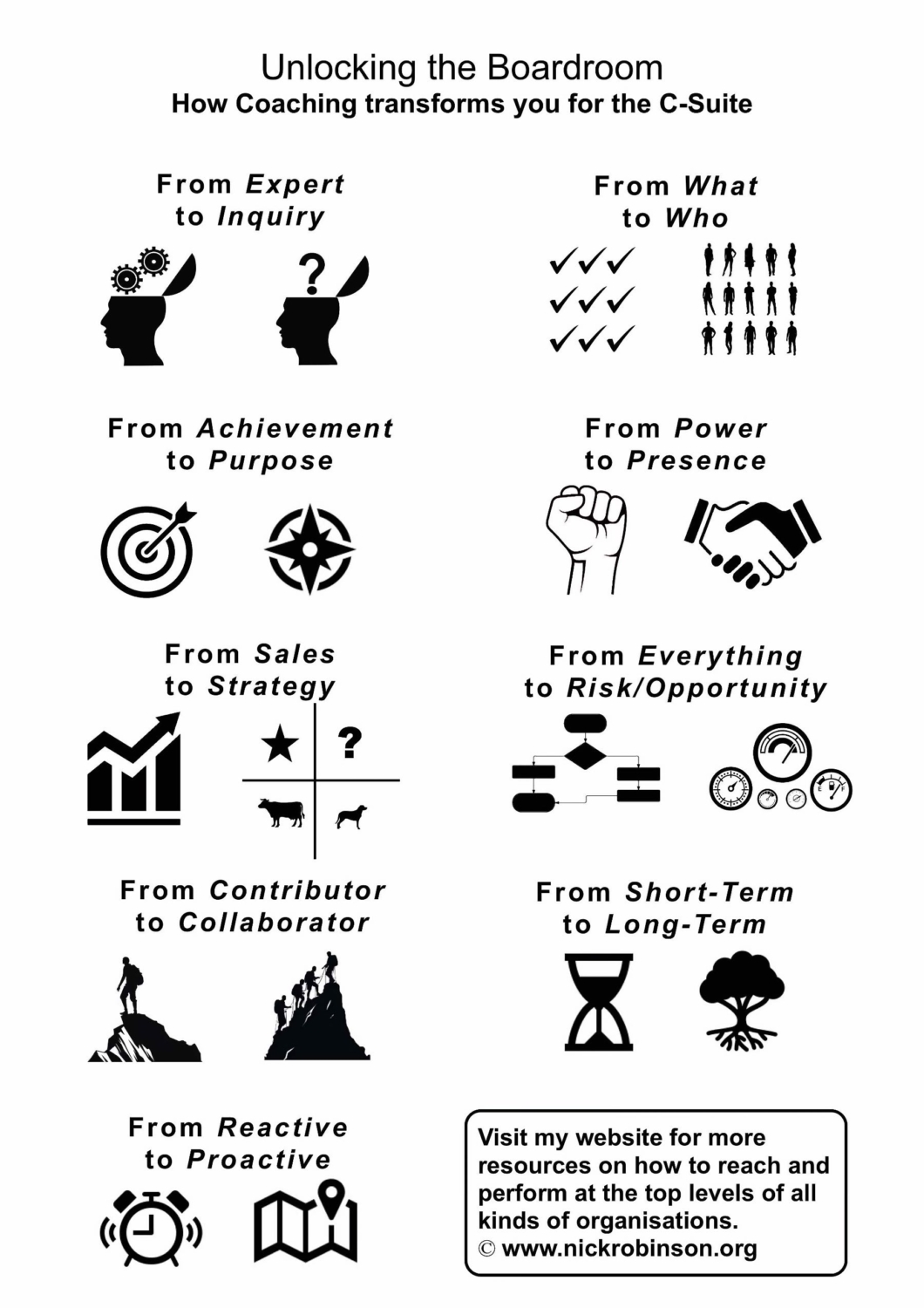
Unlocking the Boardroom: How Coaching transforms you for the C-Suite

Unlocking the boardroom isn’t just talent — it’s whole shifts in mindset. Discover the changes you’ll need to adopt to get into the C-Suite

[click the picture above and then right-click to download or save your free copy]

In today’s corporate world, talent alone won’t get you a seat in the C-Suite.

But here’s the real issue: neither will experience!

We shouldn’t be shocked at this. The landscape of leadership is changing, and clinging to old paradigms is a good way to get left behind.

It’s not just about what we know or who we know — it’s about how we think and adapt.

The best boardroom seats are reserved for those who embrace what’s needed: Transformative shifts in mindset and approach.

Want to know what it takes?

Here are the essential changes that all directors and chief officers should be working towards (with the help of their executive coach, of course) for that all-important first c-suite place in the boardroom:

From Expert to Inquiry

  • Shift from having to know everything to being part of the team that exercises mutual inquiry – asking yourselves the hard questions.

From What to Who

  • Change from knowing what needs to be done, to knowing the people who make things happen.

From Achievement to Purpose

  • Good managers do things right. C-suite board leaders make sure only the right things are being purposefully done.

From Power to Presence

  • Your responsibilities will now extend beyond your own department. You’ll need to go from exercising power and authority to cultivating presence and influence.

From Sales to Strategy

  • Even if you were never responsible for selling, you now need to make sure your whole organisation is strategically positioned to compete and be attractive in its marketplace.

From Everything to Risk/Opportunity

  • It’s no longer possible to be on top of everything. Shift from a digital mindset of managing it all to an analogue dashboard of risk and opportunity.

From Individual Contributor to Collaborator

  • Transition from being a sole achiever to harnessing the collective strengths and insights of your team, fostering a culture of collaboration and shared success.

From Short-Term to Long-Term Thinking

  • Move beyond immediate results and quick wins. As a C-suite leader, your gaze should be set on sustainable growth and crafting a legacy of long-term value.

From Reactive to Proactive

  • Instead of merely responding to the challenges that come your way, anticipate them. Lead with foresight, ensuring your organisation is always two steps ahead.

Research Highlight: The Impact of Coaching on Team Performance

Discover how coaching can transform your team! Recent research reveals it significantly boosts performance, productivity, and communication.

Some interesting academic research on the impact of coaching techniques on team performance.

I know I’m a convert, but the findings of this research really do make a strong argument for using coaching techniques to significantly boost a team’s productivity and satisfaction.

Here’s my summary and the link to the actual research study is at the end.


The study, conducted by Aldrin & Utama, revealed that the application of coaching techniques significantly improved team performance.

The team performance score (a composite measure of the quality of work, efficiency of task completion, and level of collaboration and communication within a team) was used to quantify this improvement.

Before the introduction of coaching, the average team performance score was 58.67. After coaching was implemented, the score rose to an impressive 68.53.

This shows the transformative power of coaching in a team setting, leading to:

  • higher quality work
  • improved efficiency, and
  • enhanced collaboration and communication.

Effective communication is a critical component of successful teamwork, and coaching techniques can help break down barriers, create a sense of belonging, and foster a deep empathic understanding among team members.


Coaching, as the study explains, is about building relationships that foster personal and professional growth. It’s a process that encourages individuals to find solutions to their problems through increased self-awareness, with the support of a coach.

In a team setting, coaching can help to:

  • streamline learning
  • improve job satisfaction
  • enhance interpersonal relationships, and
  • develop leadership and management skills.

Moreover, the study found that coaching techniques can enhance respect for others and provide solutions to problems.

However, it’s important to remember that the effectiveness of coaching techniques depends on their practical application in daily work.

I think that the findings of this study are a powerful reminder of the potential that lies within a teams. By implementing coaching techniques, you can unlock this potential, improving team performance and satisfaction, and driving success.

Click here to see the research paper itself.

What’s your experience been? Please use the ‘click to tweet box below, or just click here to tweet me .

How have you used coaching techniques to improve your team's performance and satisfaction at work? Share on X

Leadership Development Strategies for Success at Work: A Step-by-Step Guide

Unlock your leadership potential with my step-by-step guide. From self-assessment to continuous learning, discover my keys to your success at work.


Leadership development strategies are crucial for executive success.

They equip leaders with the necessary skills and knowledge to guide their teams effectively, drive organisational growth, and adapt to changing business landscapes.

Without leadership development, executives risk stagnation, decreased team performance, and ultimately, a decline in organisational success.


Here are the key steps to take

Step 1: Self-Assessment

Self-assessment is the foundation of leadership development.

It involves a critical evaluation of one’s strengths and weaknesses. This introspection helps identify areas for improvement.

  • An executive might use tools like 360-degree feedback or personality assessments to gain a comprehensive understanding of their leadership style and areas that need improvement.

Step 2: Setting Leadership Goals

Goal setting is a pivotal step and the GROW model is a good one to use when setting out on the developmental journey.

The GROW model involves setting a Goal, understanding the current Reality, exploring Options, and determining the Will to achieve the goal.

  • An executive aiming to improve their communication skills might set a specific goal to deliver clear and concise team briefings (Goal), acknowledge their current tendency to provide too much information (Reality), explore options like communication workshops or coaching (Options), and commit to practicing concise communication in daily meetings (Will).

Step 3: Seeking Feedback

Feedback is a valuable resource for leadership development.

It provides insights into how others perceive your leadership style and effectiveness. Constructive feedback can guide your development process.

  • An executive might implement a regular feedback system, such as anonymous surveys or open feedback sessions, to gain insights into their team’s perception of their leadership style and identify areas for improvement.

Step 4: Investigating Development Opportunities

Exploring leadership development opportunities supported by your organisation is crucial.

These programs, along with other opportunities like secondments and volunteering, provide practical leadership experience.

  • An executive might participate in a company-sponsored leadership workshop or seek a secondment opportunity in a different department, or even to a supplier or third-sector organisation, to gain a broader perspective and enhance their leadership skills.

Step 5: Raising Awareness of Others

Understanding others is a key aspect of emotional intelligence in leadership.

This involves recognizing others’ motivations and values, which can enhance team dynamics and effectiveness.

  • An executive might conduct regular one-on-one meetings with team members to better understand their motivations, career aspirations, and values, and then tailor their leadership approach to better align with these insights.

Step 6: Implementing Coaching and Mentoring

Coaching and mentoring play a significant role in leadership development.

These relationships provide personalized guidance and feedback, enhancing your leadership skills.

  • An executive might engage a professional coach to refine their communication skills, and also mentor a junior employee themselves. Which not only provides a fresh perspective but also helps in developing their leadership skills through teaching.

Step 7: Practising Leadership Skills

Practice is essential for honing leadership skills.

New skills and behaviours should be practised in a safe environment to encourage growth and development.

  • An executive might practice their decision-making skills by taking the lead in smaller projects before taking on larger, organisation-wide initiatives.

Step 8: Reflecting on Progress

Self-reflection can be an information-rich part of leadership development.

It involves reviewing your progress, learning from experiences, and making necessary adjustments.

  • After a major project, an executive might conduct a reflective session, analysing the project’s successes, challenges, and their personal performance, to identify lessons learned and plan for future improvements.

Step 9: Continuous Learning

Leadership development is a journey of continuous learning rather than a destination.

Staying updated with the latest leadership trends and theories can provide new insights and strategies.

  • An executive might commit to reading a new leadership book each month, subscribing to relevant industry podcasts, or attending annual leadership seminars to stay abreast of new developments in leadership theory.

The journey of leadership development is a continuous and rewarding process.

Each step you take not only brings you closer to becoming a more effective leader but also contributes to the success of your team and organisation.

The key to executive success lies in continuous learning, adaptation, and the courage to step out of your comfort zone. Embrace this journey with an open mind and a committed heart, and watch as you transform not just yourself, but your entire organisation.


Let me know what your top leadership development tips are? And what do you most want to learn about, as a leader? Share on X