Better Team Communications

This is one of my favourite models to use if your team isn’t communicating that well

[Click the image above and then right-click to save or download a full-size copy]

You’ll know when you have poor team communication, because there are:

  • Disagreements and conflicts all over the place
  • Misunderstandings repeating time and again
  • Rising stress levels
  • Missed deadlines
  • Lower quality than usual.

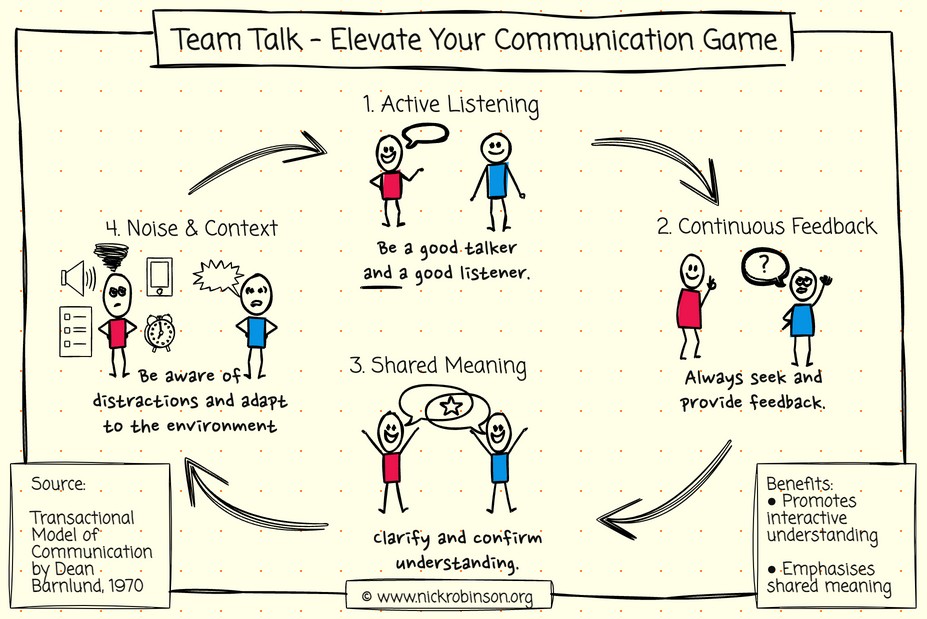
Barnlund’s model, which dates back to the ’70s, is a great way to break down a team communication problem and start practising some better ways of understanding each other.

As you can see from the diagram, there are four stages:

  1. Active Listening
  2. Continuous Feedback
  3. Shared Meaning; and
  4. (checking for) Noise and Context.

Research shows that the benefits are:

  • A more interactive understanding, rather then a passive reliance on the communicator
  • An intention to share the meaning rather than impose it.

As always, the meaning of your message is in what is understood by someone, rather than in what you actually meant to say!

Please add your own tips for great team communications on Twitter (X!). Or say something about your own experience - e.g. when does team communication really shine, and when does it go wrong? Share on X

❖ And please share this post with your network ❖

Research Highlight: The Impact of Coaching on Team Performance

Discover how coaching can transform your team! Recent research reveals it significantly boosts performance, productivity, and communication.

Some interesting academic research on the impact of coaching techniques on team performance.

I know I’m a convert, but the findings of this research really do make a strong argument for using coaching techniques to significantly boost a team’s productivity and satisfaction.

Here’s my summary and the link to the actual research study is at the end.


The study, conducted by Aldrin & Utama, revealed that the application of coaching techniques significantly improved team performance.

The team performance score (a composite measure of the quality of work, efficiency of task completion, and level of collaboration and communication within a team) was used to quantify this improvement.

Before the introduction of coaching, the average team performance score was 58.67. After coaching was implemented, the score rose to an impressive 68.53.

This shows the transformative power of coaching in a team setting, leading to:

  • higher quality work
  • improved efficiency, and
  • enhanced collaboration and communication.

Effective communication is a critical component of successful teamwork, and coaching techniques can help break down barriers, create a sense of belonging, and foster a deep empathic understanding among team members.


Coaching, as the study explains, is about building relationships that foster personal and professional growth. It’s a process that encourages individuals to find solutions to their problems through increased self-awareness, with the support of a coach.

In a team setting, coaching can help to:

  • streamline learning
  • improve job satisfaction
  • enhance interpersonal relationships, and
  • develop leadership and management skills.

Moreover, the study found that coaching techniques can enhance respect for others and provide solutions to problems.

However, it’s important to remember that the effectiveness of coaching techniques depends on their practical application in daily work.

I think that the findings of this study are a powerful reminder of the potential that lies within a teams. By implementing coaching techniques, you can unlock this potential, improving team performance and satisfaction, and driving success.

Click here to see the research paper itself.

What’s your experience been? Please use the ‘click to tweet box below, or just click here to tweet me .

How have you used coaching techniques to improve your team's performance and satisfaction at work? Share on X

Connection Overload

Is conflict at work happening because people are overwhelmed by all the relationships they need to manage?

Talking with a client recently about the number of connections with customers and team members that he was dealing with gave me an insight into a problem I’ve been seeing more of just recently. The problem is this:

Sometimes, people who are great leaders, who are brilliant at their job and whose teams are delivering great results, can simultaneously have really poor relationships with their peer group of other leaders.

Why is that?

It seems weird to me that people with the interpersonal abilities to lead and manage so successfully aren’t also able to get on well with their colleagues. Somebody with those skills would be capable of great influencing, of good listening, of super coaching. So why weren’t they always being welcomed around the boardroom table as well?

Thinking about what my client had been saying, and about the sheer volume of connections he mentioned, made me wonder about this question:

Can people be overloaded by the amount of interpersonal connections they need to manage, so that their ability to have successful relationships in all areas is impaired?

In trying to answer that question, I remembered some research I’d seen around Dunbar’s Number and Compassion Fatigue…


Readers are probably familiar with Dunbar’s Number:

the cognitive limit to the number of people we can maintain stable social relationships with

The limit is thought to be around 150 people – for relationships in which an individual knows who each person is and how each person relates to every other person. (For those people we don’t have a ‘persistent’ relationship with – don’t interact with them that often –  the number could be higher.) I wonder how close some of us get to the limits of Dunbar’s Number, when we consider all of the client, supplier, colleague and team-member relationships we need to focus on? 150 isn’t a huge number. If you added up all the people you need to regularly connect well with, what does it come to?


Research also shows that there are limits to Empathy too.

Empathy: the ability to understand and share the feeling of others.

Empathy is limited in a number of ways, two of which are significant here:

  1. Empathy is limited in that it depletes our mental resources – the effort of keeping information in mind is mentally and physically draining. This is why people in caring professions are warned about the dangers of compassion fatigue.
  2. Empathy is also limited in that it’s a finite resource until refreshed. Using empathy in one area of our work and lives reduces the amount available for other areas. This was shown by a study (click here) in which people who reported taking time to listen to colleagues’ problems and worries and helping others with heavy workloads felt less capable of connecting with their families. They felt too emotionally drained and burdened by work-related pressures to also be empathic at home.

Putting together the Dunbar’s number data and this sense of empathy as a limited resource, made at least part of this issue clearer for me. This is why some clients – often those who are otherwise great leaders – might sometimes struggle to be effective in relating to their wider peer-group. It’s quite possible that they are overwhelmed by the volume and range of relationships they need to manage.

If you’re at the head of an organisation, and you notice that some of your team leaders don’t seem to be getting on with each other, this idea of connection-overload might be one place to look.

Some questions to ask might include:

  • Are some of your team leaders having to spread their cognitive powers too thin, having to ‘know’ the preferences etc of too many people?
  • Is their empathy overloaded – their ability to relate well to others simply depleted?

Tell me about connection-overload in your organisation or for you personally. Where are the limits of your empathy? What’s your own Dunbar’s Number?